



Learning to Vote
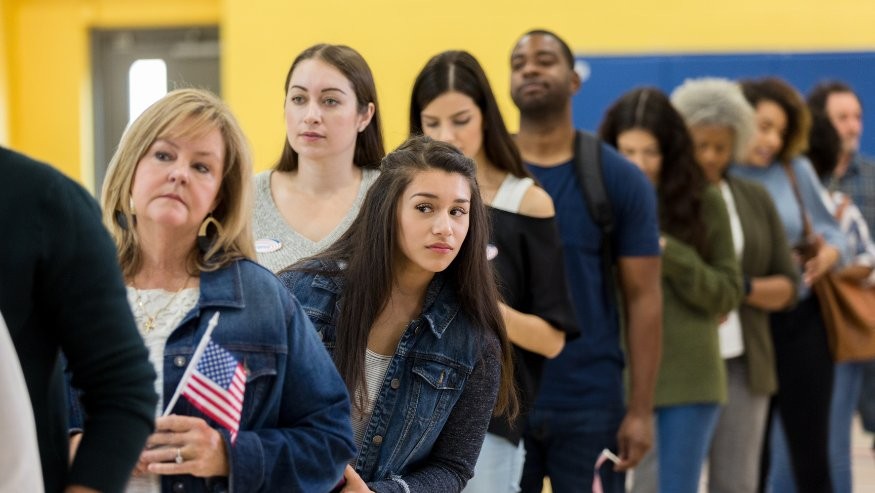
High schools should lead voter registration efforts
Each generation has a duty to prepare young people for their responsibilities as adults. Through universal education, students learn to read and calculate. They learn about science and history. Public education also has a vital civic purpose: preparing each student to participate in society.
California High School Voter Education Weeks: April 13-24, 2026
Voting is the basic act of participation in a democracy. Votes determine how schools are funded, how public safety is maintained, and how governments at every level respond to issues that shape the future. The future is at stake. All voices should be heard, including the voices of teens. Registering each teen to vote should be routine and normal, not the exception. In California, registration can happen anytime after a student's 16th birthday… but it rarely does.
Compared to other states, California has a weak record of youth voter participation. The numbers are dreadful. If this surprises you, you aren’t alone.
High schools prepare future voters. They are the natural place to make voter registration a normal part of becoming an adult. This post explains specific steps you can take in your community to help address low youth voter participation. It also explores some policy changes that could help.
Let’s start with the big picture.
Other states do better than California at registering young people to vote
Most California students graduate high school without registering to vote. Despite California’s reputation as a civic-minded state, less than half of 18-year-olds in the state are registered to vote. According to research by CIRCLE at Tufts University, many states do better at engaging young voters:
These states show that it’s possible to dramatically increase youth voter registration rates. The Civics Center, an organization that focuses on democratic participation, evaluated each state’s policies for voters up to age 29. The takeaway: while good policies for registration and voting matter, the biggest obstacle to voting is inaction. Voting for the first time can feel intimidating. Minnesota, which has among the nation’s highest youth participation rates in elections, overcomes inaction through a statewide constellation of organizations that work with individuals directly.
California counties have varied levels of success when it comes to registering young voters. Even the best counties fall far short:
Policy changes could help lift these low rates, and we’ll review some options in a moment. But before we go there, let’s stay with the big finding: voter registration is a one-by-one process. Systems that boost youth voter participation have to engage each new voter directly. One effective approach is to meet students where they are — in high school.
How to run a registration drive for new voters
The Civics Center, a California-based non-partisan organization, is on a mission to make voter registration part of every high school, in partnership with the California State PTA. The key to success for a registration drive is for students to run it, but PTAs, educators, and advocates can provide support to help make it happen.
You don’t have to start from scratch. Here are some of the resources the Civics Center provides to help you build a voter registration drive in your school community:
Students who want to run voter registration drives get free online training with sessions available throughout the school year. Democracy-in-a-Box gives you the materials you need to get started. More information here.
Put this logo on your school and PTA websites, linked to registertovote.ca.gov.
PTA leaders and school staff can get free training from The Civics Center for their roles as advisors and supporters, including the option of conversations with experts. A toolkit provides an overview of California voter registration laws. Run a Drive Workshops include a checklist of the tasks for students to manage, with worksheets to help keep track of laws, deadlines, and your to-do list when organizing. The California Secretary of State explains the state rules for a voter registration drive.
Advocates who want to raise awareness and get support from school district officials receive customized letter templates to spread the word to students, teachers, school principals, and school district officials. There is a sample school district resolution to encourage administrators and board members to set explicit voter education policy. More information here.
Outreach materials. Check the Civics Center’s substantial library of useful graphics.
Schools develop citizens. Counties register voters. Alas, the process runs through DMVs.
High schools run processes that routinely involve each student. They check attendance. They issue school IDs, report cards and diplomas. Yet, when it comes to ensuring that each California student registers to vote schools haven’t played the central role. Why? Because the system focuses on drivers, not on citizenship.
California created the Department of Motor Vehicles (DMV) in 1915. Then, as now, the department served as an important revenue source by collecting fees on registration of vehicles and issuance of licenses.
In the past, it was common for Californians to get their driver’s license as teens. To promote responsible driving, many high schools routinely offered a driver’s education course as an elective. In 1990, federal funding for driver’s education was discontinued, contributing to the decline in teen driving.
The DMV’s role in elections grew out of county registrars’ need to authenticate voters effectively and efficiently. Proof of age and identity are central requirements for voting, and also for obtaining a driver's license or Real ID card. These verification responsibilities have been centralized in the Department of Motor Vehicles (DMV) as an outgrowth of motor voter laws. In many states, a government-issued ID (in practice, usually a driver’s license) is required as a condition to vote.
In California, the paperwork required to prove residency and identity for the purpose of voting is somewhat less restrictive than that for driving, but in practice the DMV has become the primary gateway to voting.
As fewer teens became drivers, fewer became voters.
The logistical connection between driving and voting has always been a barrier to youth participation in elections. For a licence, you have to make an appointment with the DMV or wait in line. You need to get there in person with the right paperwork in hand, accompanied by a parent. Even just to register for a state-recognized REAL ID involves a bit of hassle and costs some money. Getting a driver’s license involves multiple steps including a vision test, written test, road test, fees, proof of insurance, access to a car, and a Social Security Number.
The minimum driving age in the state starts with a learning permit as early as age 15 1⁄2. Over time, fewer teens are driving, so many choose to put off getting a license or state ID. If you need to board a flight or appear at a courthouse, you need a REAL ID or driver’s license, but not until you turn 18.
To be clear: It is easiest to vote in California if you have a driver’s license or REAL ID, but as of 2026 it’s possible to vote without one. At no cost, you can cast a provisional ballot in person by presenting essentially the same documents you would need for a REAL ID, including your name, address and signature. Provisional votes are verified before they are counted, a process that can take time.
States vary significantly in their ID rules for voting. As of this writing in March, 2026, it appears that California voters might be asked to weigh in on a ballot initiative about whether to change the state’s rules for voting in person.
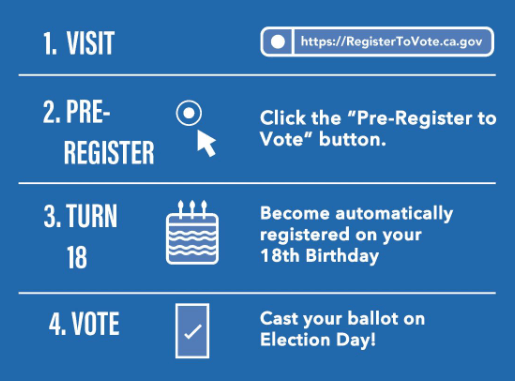
Register at 16 to vote at 18. No car required.
The DMV is the wrong gateway to civic adulthood
The systems that transition young people into life as voters aren’t working. Writing for the Civics Center, Laura Brill points out that “our current registration systems miss high school students in the millions, year after year.”
Should this surprise us? Does anyone really love a visit to the DMV? Somehow, the formal transition to civic adulthood has become mixed up with joyless paperwork at the desk of an unfamiliar bureaucrat.
It doesn’t have to be this way. Pre-registering to vote could be a celebrated milestone in high schools, where students already learn about civics and government.
Notice the word could in the previous sentence. Unfortunately, few schools are in the habit of getting students to pre-register to vote.
The chart below, from the 2024 annual report of the California Secretary of State, shows the low level of pre-registrations among 16 and 17-year-olds in the state.
How bad is it? In 2024 the combined volume of pre-registrations for 16- and 17-year-olds in the state amounted to about 123,000 individuals — a rate of about 12%. Even among those 16- and 17-year-olds who do get their driver’s license, about 40% opt out of registering as voters in the process.
Relying on driving as the trigger to register to vote isn’t working.
Ideas for reform: Time for a task force
Focus on humans, not cars
The onramp to formal civic adulthood needs to be redesigned with humans at the center, not cars. Youth civic disengagement is bad for democracy, and should be seen as a crisis. Suppose a state task force were charged with developing ideas for reform — here are a few themes such a group might consider:
- Reduce costs for students to pre-register. For example, waive the REAL ID registration fees for students who pre-register before their 18th birthday.
- Reduce practical barriers. For example, create “mobile DMV” capabilities to hold REAL ID registration events at high schools. Alternatively, create a process to authorize high schools or school districts to issue REAL IDs, like DMVs do, in compliance with federal law.
- Involve high schools in the process. California already requires high school students to take a course in U.S. government. It's a graduation requirement. The class covers the basics of voting, but strangely omits the practical act of registering. Make it part of the class.
- Increase transparency and accountability. For example, add pre-registration data and benchmarks to the California School Dashboard for counties and state Assembly districts. At present, this public data is not made public, though there is said to be a way to request it through the office of the Secretary of State.
- Celebrate success. For example, provide state recognition for high schools with the highest rates of student voter registration. Within districts, recognize high schools with the highest rates of voter pre-registration. Conduct a “sweet 16” campaign to reward high schools that achieve high pre-registration rates among students before their 17th birthday.
How to build youth civic knowledge and engagement
Elections aren’t the end goal. Think bigger.
Reforms like the ones suggested here will take time to be enacted. Meanwhile, teen participation in elections is a measurable part of a larger goal: building a continuous pipeline of informed, participating citizens. What is your high school doing to promote civic learning?
- Are students participating in Mock Elections?
- Has the school applied for the Civic Learning Award?
- Is it participating in the State Seal of Civic Engagement program?
- Are students volunteering to be poll workers?
Many students in California have an interest in leadership. Two inspiring student-run organizations worth knowing about include GENup and CASC. Both offer summer leadership programs.
In the context of elections, one notable program from GENup is its toolkit for a School Board Town Hall, where students invite school board candidates to speak to students to answer their questions and learn their priorities. Another is its toolkit for establishing student board members in your school district, which is easier than you might imagine.
This post was extensively updated in March 2026.
Tags on this post
Civics Student voice VoteAll Tags
A-G requirements Absences Accountability Accreditation Achievement gap Administrators After school Algebra API Arts Assessment At-risk students Attendance Beacon links Bilingual education Bonds Brain Brown Act Budgets Bullying Burbank Business Career Carol Dweck Categorical funds Catholic schools Certification CHAMP Change Character Education Chart Charter schools Civics Class size CMOs Collective bargaining College Common core Community schools Contest Continuous Improvement Cost of education Counselors Creativity Crossword CSBA CTA Dashboard Data Dialogue District boundaries Districts Diversity Drawing DREAM Act Dyslexia EACH Early childhood Economic growth EdPrezi EdSource EdTech Education foundations Effort Election English learners Equity ESSA Ethnic studies Ethnic studies Evaluation rubric Expanded Learning Facilities Fake News Federal Federal policy Funding Gifted Graduation rates Grit Health Help Wanted History Home schools Homeless students Homework Hours of opportunity Humanities Independence Day Indignation Infrastructure Initiatives International Jargon Khan Academy Kindergarten LCAP LCFF Leaderboard Leadership Learning Litigation Lobbyists Local control Local funding Local governance Lottery Magnet schools Map Math Media Mental Health Mindfulness Mindset Myth Myths NAEP National comparisons NCLB Nutrition Pandemic Parcel taxes Parent Engagement Parent Leader Guide Parents peanut butter Pedagogy Pensions personalized Philanthropy PISA Planning Policy Politics population Poverty Preschool Prezi Private schools Prize Project-based learning Prop 13 Prop 98 Property taxes PTA Purpose of education puzzle Quality Race Rating Schools Reading Recruiting teachers Reform Religious education Religious schools Research Retaining teachers Rigor School board School choice School Climate School Closures Science Serrano vs Priest Sex Ed Site Map Sleep Social-emotional learning Song Special ed Spending SPSA Standards Strike STRS Student motivation Student voice Success Suicide Summer Superintendent Suspensions Talent Taxes Teacher pay Teacher shortage Teachers Technology Technology in education Template Test scores Tests Time in school Time on task Trump Undocumented Unions Universal education Vaccination Values Vaping Video Volunteering Volunteers Vote Vouchers Winners Year in ReviewSharing is caring!
Password Reset
Search all lesson and blog content here.
Login with Email
We will send your Login Link to your email
address. Click on the link and you will be
logged into Ed100. No more passwords to
remember!








Questions & Comments
To comment or reply, please sign in .
Carol Kocivar August 27, 2025 at 2:12 pm
The California State Archives presents their newest exhibit titled “The Journey to Democracy: Celebrating the Sixtieth Anniversary of the Voting Rights Act.” This exhibit explores what is arguably the most important civil rights legislation enacted by Congress in the 20th century with facsimiles of historic photographs and documents from the Library of Congress and the Lyndon Baines Johnson Library and Museum supplemented with original records from the collections of the State Archives.
https://www.sos.ca.gov/archives/public-events/exhibits-2