



Vaccinations and Schools

Saving lives together
Not so long ago, childhood diseases like whooping cough, chicken pox, measles, mumps and rubella claimed the lives of thousands of American children every year. Many children who survived were left with scars or chronic health problems.
Anti-vax politics vs saving lives
Schools have made those scourges a thing of the past through universal vaccination — one of the most successful medical interventions in human history. By ensuring that all children are vaccinated, these terrible diseases became rare — the stuff of history lessons, not daily news.
As schools get started each year, part of the work of keeping kids safe involves an important bit of paperwork: ensuring that each student has been properly immunized. The beneficial impact of this policy has been massive.
According to the Centers for Disease Control (CDC), “Among children born during 1994–2023, routine childhood vaccinations will have prevented approximately 508 million cases of illness, 32 million hospitalizations, and 1,129,000 deaths, resulting in direct savings of $540 billion and societal savings of $2.7 trillion.”
Students in California must be vaccinated to attend school.
The "anti-vax" movement remains dangerous
Despite this success, or perhaps because of it, it's easy to assume that "old" diseases are no longer a threat. Some public figures (notably Robert F. Kennedy Jr.) have made themselves famous, or infamous, by sowing doubt about whether vaccinations are safe or necessary. Doubt causes hesitation, and vaccination rates have declined in some places. Until 2016 it was legal for parents in California to enroll unvaccinated children in public school simply by registering a personal belief statement. An outbreak of measles in 2025-26 is an important reminder: these diseases are still a deadly reality.
If they are allowed to come back, children will die.
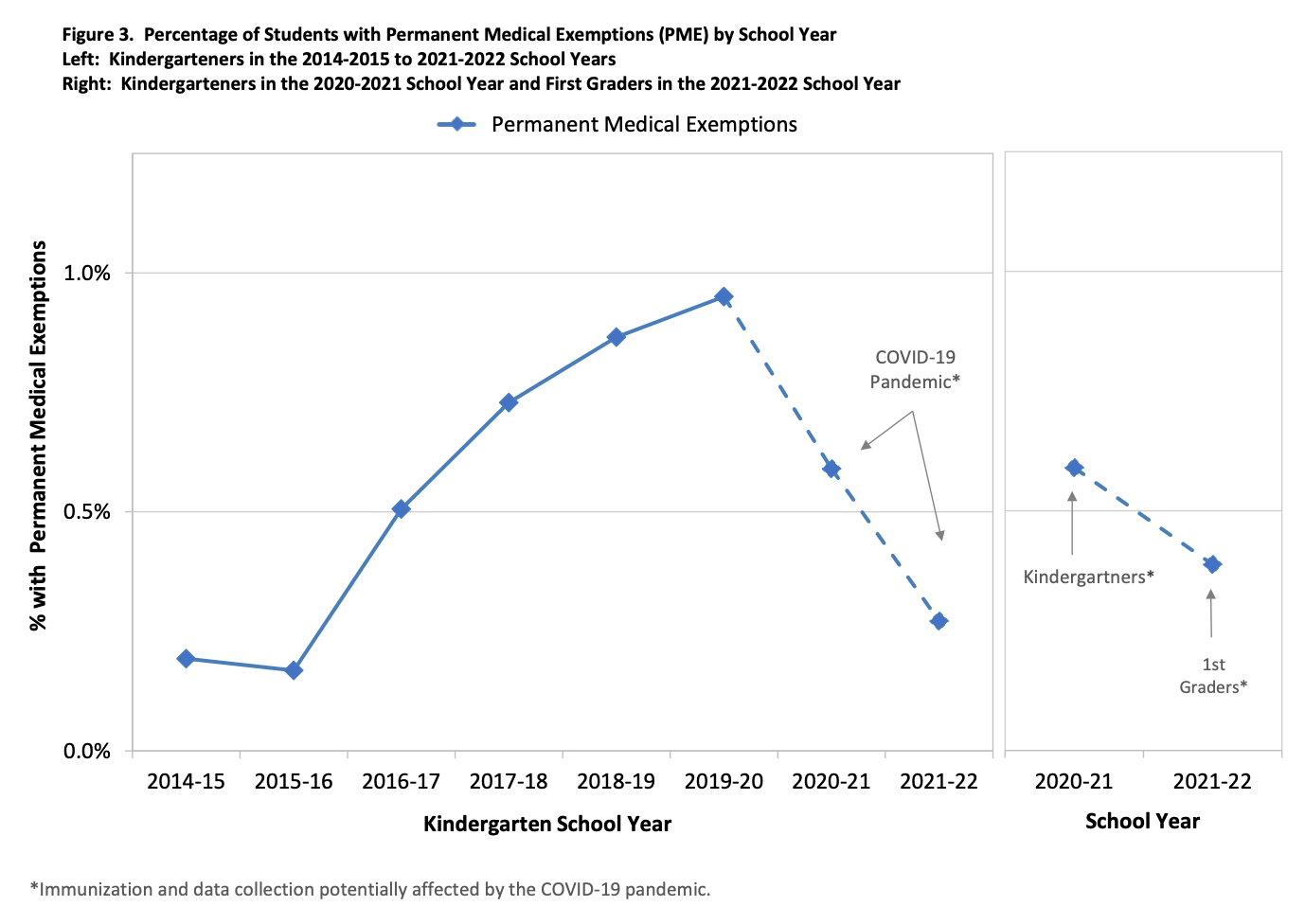
To protect children and the general public, in California each child must be immunized unless there is a specific, medically valid reason to leave them vulnerable. Prior to 2016, the rules were fuzzy: families could “exempt” their children from vaccination on the basis of “personal belief.” Unfortunately, doubt is contagious. Gradually, "pockets" developed where outbreaks could begin and spread. In 2016 the California Legislature tightened the rules. Parents can still leave their kids unprotected, but only based on "physical condition or medical circumstances." When the California Department of Health enforced the law, public safety from outbreaks improved.
Each School Counts
According to the California Department of Public Health, at least 95% of children at each school must be immunized to prevent transmission of disease.
Outbreaks are most likely in school communities where anti-vaccination beliefs take root. If groups of parents take measures to “exempt” their children from protection, diseases are more likely to spread.
Check your school's immunization rate
In most schools, immunization rates are safely above the levels recommended by the California Department of Public Health (CDPH). For county-level data about kindergarten vaccination vulnerability, see CDPH maps. Schools known to be vulnerable tend to have relatively small enrollment, and tend to be located in rural areas. Some schools
Is your school among those susceptible to an outbreak? CDPH audit assessment results are public data for grades K and 7. If your school has failed to report data or doesn't meet standards, it's on the list.
Schools that fail to get students vaccinated lose attendance funding for them. In 2026, EdSource reported that the total amount lost funding for schools amounted to more than $2 million.
In the past, CDPH has presented vaccination rate data in the form of a map of schools, but as of this writing in 2026 the site is too far out of date to be worth much.
What about flu and COVID vaccinations?
Flu and COVID viruses can both be fatal, but vaccinations for these diseases are not required for enrollment in California schools.
Does that mean students shouldn't get vaccinated? Far from it. The Centers for Disease Control and Prevention (CDC) recommends that children be vaccinated every year: "Everyone 6 months and older should get a flu vaccine every [flu] season with rare exceptions. Vaccination is particularly important for people who are at higher risk of serious complications from influenza." The CDC guidance is almost the same for COVID.
As of 2026, public confidence in guidance from the CDC has declined under the leadership of Robert F. Kennedy, Jr., who has been inconsistent in support of universal vaccination policies. In response, states have formed alliances to provide guidance to their residents about which immunizations they recommend or require.
|
CDC guidance about flu and Covid vaccinations |
|
|---|---|
|
Flu |
Everyone 6 months of age and older should get a flu vaccine every year. It's the first and best way to protect against flu. |
|
Covid-19 |
Everyone aged 5 years and older should get 1 dose of an updated COVID-19 vaccine. Children aged 6 months–4 years may need multiple doses to be up to date. |
Which vaccinations are required in California?
Required immunizations vary by age.
|
Summary of requirements |
|
|---|---|
|
What shots does my child need and where can we get them? |
|
|
Which vaccines are required for school? |
|
|
HPV required notices: Cancer prevention |
Starting in 2024, the California Cancer Prevention Act requires schools to notify families of 6th graders about human papillomavirus (HPV) vaccination recommendations. Schools can use this Template Letter to Parents. |
What do other states require?
Vaccines work through herd immunity. To work, they have to be widely used, and the US Supreme Court ruled in 1905 that states have the authority to require them. Even so, such mandates always been controversial. According to the National Academy for State Health Policy, state legislatures in Florida, Texas, and 19 other states have banned schools from requiring vaccination against Covid.
If you find that your school community has a lot of unvaccinated children or faculty members, be thoughtful about how you approach the problem. Changing someone's mind can be difficult. A clumsy confrontation can make it even harder. A podcast episode from Hidden Brain, Facts Aren't Enough, might be of use.
Updated March 2026.
Tags on this post
Health Kindergarten VaccinationAll Tags
A-G requirements Absences Accountability Accreditation Achievement gap Administrators After school Algebra API Arts Assessment At-risk students Attendance Beacon links Bilingual education Bonds Brain Brown Act Budgets Bullying Burbank Business Career Carol Dweck Categorical funds Catholic schools Certification CHAMP Change Character Education Chart Charter schools Civics Class size CMOs Collective bargaining College Common core Community schools Contest Continuous Improvement Cost of education Counselors Creativity Crossword CSBA CTA Dashboard Data Dialogue District boundaries Districts Diversity Drawing DREAM Act Dyslexia EACH Early childhood Economic growth EdPrezi EdSource EdTech Education foundations Effort Election English learners Equity ESSA Ethnic studies Ethnic studies Evaluation rubric Expanded Learning Facilities Fake News Federal Federal policy Funding Gifted Graduation rates Grit Health Help Wanted History Home schools Homeless students Homework Hours of opportunity Humanities Independence Day Indignation Infrastructure Initiatives International Jargon Khan Academy Kindergarten LCAP LCFF Leaderboard Leadership Learning Litigation Lobbyists Local control Local funding Local governance Lottery Magnet schools Map Math Media Mental Health Mindfulness Mindset Myth Myths NAEP National comparisons NCLB Nutrition Pandemic Parcel taxes Parent Engagement Parent Leader Guide Parents peanut butter Pedagogy Pensions personalized Philanthropy PISA Planning Policy Politics population Poverty Preschool Prezi Private schools Prize Project-based learning Prop 13 Prop 98 Property taxes PTA Purpose of education puzzle Quality Race Rating Schools Reading Recruiting teachers Reform Religious education Religious schools Research Retaining teachers Rigor School board School choice School Climate School Closures Science Serrano vs Priest Sex Ed Site Map Sleep Social-emotional learning Song Special ed Spending SPSA Standards Strike STRS Student motivation Student voice Success Suicide Summer Superintendent Suspensions Talent Taxes Teacher pay Teacher shortage Teachers Technology Technology in education Template Test scores Tests Time in school Time on task Trump Undocumented Unions Universal education Vaccination Values Vaping Video Volunteering Volunteers Vote Vouchers Winners Year in ReviewSharing is caring!
Password Reset
Search all lesson and blog content here.
Login with Email
We will send your Login Link to your email
address. Click on the link and you will be
logged into Ed100. No more passwords to
remember!




Questions & Comments
To comment or reply, please sign in .
Jeff Camp - Founder August 21, 2019 at 3:54 pm
August 21, 2019 at 9:43 am