




Photo by Allison Shelley
The Verbatim Agency for EDUimages
Students spend about a thousand hours in school each year. The spaces where they learn can affect their health, comfort, safety, and ability to focus and interact with others.
In This Lesson

What makes a good learning environment?
Do school facilities affect learning?
What is a reasonable opportunity to learn?
How are school facilities funded?
How do school bonds work?
How does a local school bond measure get on the ballot?
How much is spent on K–12 schools in the USA?
How are local school bonds passed?
How has the state supported school construction and renovation?
Is funding for school facilities in California fair?
What does California know about school facilities?
Why does California help pay for school facilities?
How are charter school facilities funded?
How is climate change changing schools?
▶ Watch the video summary
★ Discussion Guide
For many years, the quality of school facilities was widely dismissed as a nice-to-have aspect of educational quality — far less important than prepared teachers and good learning materials. After all, Socrates taught on a rock, right?
As this lesson will discuss, school facilities are more than just buildings — they are part of the educational experience for students, and a workplace for educators. Everyday factors such as temperature, air quality, noise, lighting, and access to technology influence how people interact with one another. California's school facilities vary massively, predictably, unequally, and yet invisibly, because the state collects little data about them.
What makes a good learning environment?
Learning happens in the brain, but education happens mainly in physical places. Schools need classrooms of the right sizes. They need labs, libraries, performance spaces, practice spaces, playgrounds, athletic fields, parking access, storage spaces, and HVAC systems to keep everyone comfortable. Some aspects of a facility are easy to overlook, like wiring, air filtration, lead-free plumbing, and shade.
The pandemic demonstrated that schools also need good digital facilities, including networks, computers, screens, software, and the knowhow to use them. Nothing is free, and in California there have been many gaps.
Do school facilities affect learning?
Design has consequences for learning.
Design choices constrain how learning happens. For example, if a cramped classroom can only hold about 30 students sitting in rows, it's likely that's how instruction will be organized. Some programs, such as laboratory science, require plumbing and ventilation. Young kids need nearby bathrooms. Performing arts require special spaces for rehearsals and performance. Music programs need acoustically suitable spaces. PE programs are strongly influenced by facilities: a school with access only to paved spaces for recreation will emphasize basketball. A school with ready access to a grass field might offer soccer.
School facilities are more than a backdrop for learning. They define the boundaries.
What is a reasonable opportunity to learn?
California schools must provide every child with a reasonable opportunity to learn. This principle gained the force of law in California through the 2004 settlement of what's commonly known as the Williams case. The plaintiffs documented major disparities in health and safety factors in their schools, such as vermin or broken toilets, and academic disadvantages, such as missing textbooks and inexperienced teachers. The expression opportunity to learn came to be used as shorthand for the connection between decent facilities and learning.
In California, the learning conditions identified in the Williams settlement must be described in each school's School Accountability Report Card (SARC), a formal report that is supposed to be made public by February 1 every year. The meaning of safe school facilities under the settlement includes things such as lighting, temperature, safe bathrooms and playgrounds, and accessibility for people with disabilities.
The Williams settlement established a floor for what a school must not be, not a vision for what it should or could be. The quality of school facilities varies dramatically and systematically from place to place depending on local property wealth.
How are school facilities funded?
Schools depend on two types of funding for two types of expenses:
Operating Expenses: California's main school finance system for the day-to-day operating expenses of schools is known as the Local Control Funding Formula (LCFF), explained in Ed100 Lesson 8.5. Under LCFF, school districts receive base funding to pay teachers and staff based on the number of students in attendance, with some additional money for specific needs. The revenue to pay for these operating expenses comes from a combination of local property taxes and (as needed) state taxes, bringing each school to a guaranteed level of funding per student.
Why wealthier neighborhoods have nicer school facilities
Capital Expenses (Facilities): Costs related to the purchase, construction, or modernization of school facilities (known as capital expenses) are not part of LCFF. Following standard accounting practices, capital assets in school systems — expensive stuff like buildings, equipment, and heat pumps — are accounted for in a way that spreads their cost over time. Whereas operating expenses pay for things that are gone once spent, like a day of teacher salary, capital expenses pay for assets — stuff that stays useful for a while and depreciates in value over time as it wears out.
The costs of operating public schools are shared between the state (via income taxes) and the local community (via property taxes). The capital costs of building or renovating schools are largely not shared. Each local community, whether rich or poor, mostly pays for its local school facilities through its own property taxes. This explains why kids who live in wealthier neighborhoods have nicer school facilities. It also helps explain why school attendance boundaries are so difficult to change.
Before we go on to research about the implications and ideas to make the system fairer, here's a recap:
| Operating funding | Facilities funding | |
|---|---|---|
| What it pays for | Teachers, staff, supplies, services, utilities, and daily school operations | Land, buildings, renovations, equipment, playgrounds, HVAC systems, and major repairs |
| Who pays | State income taxes and some local property taxes (LCFF) | Local property taxes, mostly |
| How often it is needed | Every year | Irregularly, but forever because needs change and buildings wear out |
| Equity approach | Strong: LCFF directs more state money to districts serving students with greater needs | Weak: No additional funds for poorer communities |
This lesson will explore research about how to make this unequal system fairer, but first we have to explain how districts borrow money.
How do school bonds work?
It costs a lot of money to build or renovate a school. Districts don't have that kind of money in the bank. When a school district needs to build or renovate a school, it borrows the money using bonds.
The language used to describe school bonds can be confusing: when school districts sell or issue bonds, what they are really doing is borrowing. Like a mortgage, money borrowed with a bond must be paid back over time, with interest, through taxes on property owners in the school community. In most cases this is known as a General Obligation (GO) Bond.
You might be wondering: Why spend money on interest payments? School facilities always wear out over time. It's inevitable, right? Couldn't school districts just save up in anticipation of future facilities needs? By doing so they would earn interest on the money saved and have more to spend. It's possible for school districts to do this, and some do. But it doesn't often happen.
Imagine yourself as a school board member and consider the politics: Bond financing is fairly easy to get, especially if your district is well-run. It's standard practice, with clear rules and limits. Saving for future facilities means saying "no" to real, current needs. Passing a bond increases taxes, which brings in new money. Your term on the board is short, your constituents are clamoring for action, and financing is available. Oh, and there's a chance that future board members would spend the money you set aside in ways you disagree with.
Investors buy school facility bonds as a business transaction. They make money on the deal, usually as tax-free interest. The specific rules for each bond, known as its structure, can vary, including the amount borrowed, what the money may be used for, the interest rate, the timing of when money changes hands, and more. The price of the bond varies partly on the creditworthiness of a school district. Households and businesses in the district pay off the debt through local property taxes, based on the assessed value of their property.
How does a local school bond measure get on the ballot?
In California and elsewhere, school boards have the authority to place a school bond measure on the local ballot for their district. In most states, a local school facilities bond must be approved by a majority of voters. In California, a supermajority of 55% is required. In some states the hurdle is even higher:
California's voters set the 55% supermajority requirement decades ago by passing Proposition 39 (2000), which lowered the threshold from a 2/3 supermajority. At a high level, the State Treasurer tracks debt associated with school bonds to help ensure that districts stay within established limits.
How much is spent on K-12 schools in the USA?
According to estimates by NEA, total spending on K-12 public education in the USA surpassed a trillion dollars for the first time in 2024-25. Of that amount, about a tenth paid for facilities and for interest on the bonds used to finance them.
In California, NEA estimated that $143B was spent on K-12 education in 2025-26, including $11.4B for capital outlay (mostly school construction and modernization) and $3.3 billion for interest.
How are local school bonds passed?
It takes organization to pass a local school bond measure. District leaders must identify facilities needs, develop a plan, communicate it clearly, and build public confidence. Local supporters must persuade voters that the projects are necessary and that the district can manage the money responsibly. In most cases, local school bond measures in California require a citizen oversight committee to ensure that the funds are used for their intended purpose. Mistakes can be costly.
It's a complex process, and not all school districts know how to do it. Wealthy communities tend to have high expectations of what their schools should offer. They also have more valuable property to tax, more experience running campaigns, and more ability to hire expert help. Communities with greater needs tend to have fewer of these advantages.
How has the state supported school construction and renovation?
California voters have repeatedly approved state bonds for school facilities.
Over decades, about 90% of the costs of school construction and renovation in California have been paid for by local property taxes, but state funds have played a role, too. From time to time, California voters have passed initiatives to set aside state funds for school facilities. These funds have often been structured as matching grants: to qualify for them, local communities usually have had come up with money of their own.
Is funding for school facilities in California fair?
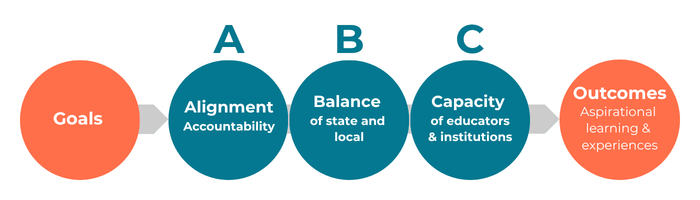
In 2026, a highly anticipated research project, Getting Down to Facts III, examined the role of school facilities in learning, along with many other important subjects. The key paper related to school facilities was written by Sara Hinkley and Jeff Vincent. According to their research, the bonding system creates a predictable tilt in which students get the benefit of upgraded facilities and which don't:
In California, school facilities depend heavily on local wealth.
Echoing prior research, Hinkley and Vincent found that California's system for funding school facilities depends deeply on local property wealth. Communities with more property wealth can raise more money locally for school construction and renovation. Communities with less property wealth have less capacity to do so:
Capital revenues by bonding capacity quintile, enrollment weighted, 2004-25
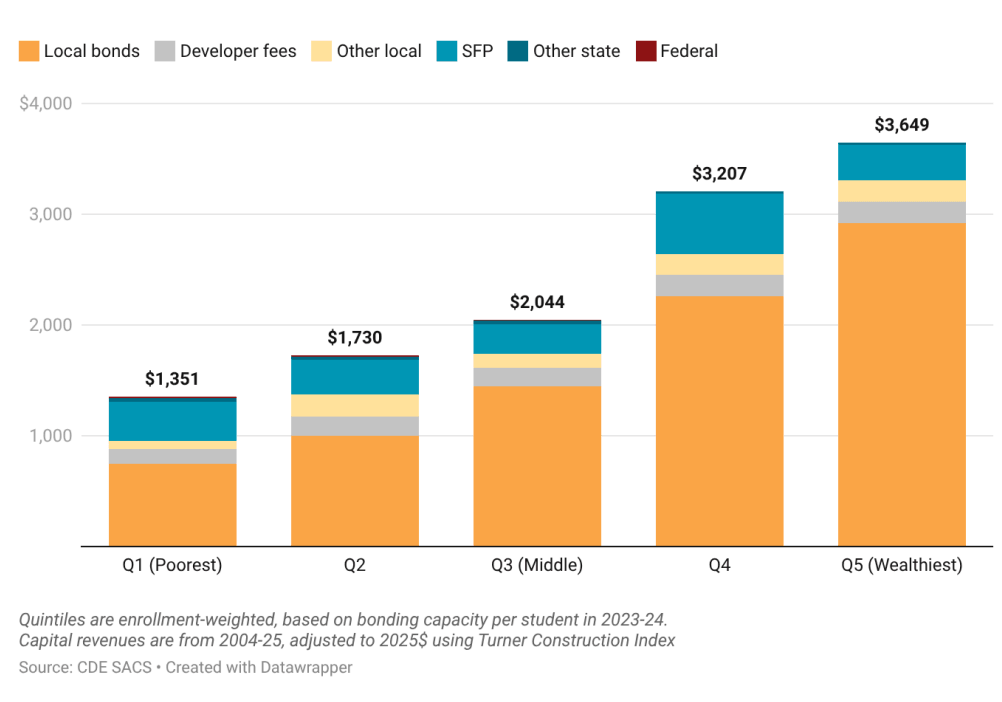
Source: Getting Down to Facts III, Hinkley and Vincent.
Unequal access to funding for school facilities in California has drawn legal attention. In 2026, EdSource reported on a lawsuit challenging California's school facilities funding system. The case argues that California's approach leaves students in poorer communities with systematically inferior access to safe, modern learning environments. The lawsuit may take years to resolve.
In separate research in 2023, a small team of researchers (Biasi et al.) examined school capital projects throughout the United States to look for evidence of impact on learning and on home values. They found it:
“On average, bond authorization significantly raises test scores and house prices. Yet, there are large differences across bonds and districts. Spending on infrastructure renovation and upgrades, such as HVAC or roofs, raises test scores but not house prices; conversely, spending on athletic facilities increases house prices but not test scores. Bond authorization is most beneficial in districts with more disadvantaged student populations, in part because these districts prioritize bonds that improve learning.”
What does California know about school facilities?
California collects surprisingly little information about the condition of school facilities.
This has repeatedly been one of the most striking findings from research about school facilities in California. California collects extensive data about students, attendance, test scores, graduation rates, staffing, budgets, and demographics. But when it comes to the actual places where students learn, the state's information is far weaker.
We don't know which schools lack air conditioning.
California does not maintain a comprehensive statewide database of school facilities and their condition. How old is each building? How large is it? It is unused, or unusable? Does it have air conditioning? Which schools have mold, poor ventilation, or other health and safety problems? Is it crowded? Which schools lack the facilities needed to expand transitional kindergarten or career technical education?
“[F]undamentally, California lacks any systematic statewide data on the physical condition or adequacy of school facilities. We rely on financial measures—revenues received and expenditures made—as proxies for facility investment, but these cannot speak to the actual state of school buildings. The Facilities Inspection Tool (FIT), the only required statewide facility condition assessment, has been found by the State Auditor to be unreliable. This data gap is itself a finding of the study.”
— GDTFIII, Hinkley & Vincent page 62.
This lack of information makes questions of equity hard to assess and address. Without better data, it is difficult to target resources where students are most affected. California has a school facilities problem and a school facilities data problem.
Why does California help pay for school facilities?
Historical context
The state has played a role in school facilities for a long time. California voters and lawmakers have repeatedly agreed that local taxpayers should not be the only source of money for school construction and renovation.
In 1933, following a major earthquake, California adopted the Field Act, which established building standards for public schools. In later decades, as California's population grew rapidly, the state issued bonds to help support the construction of new schools. In the 1970s, the state also helped districts address needs for modernization and earthquake-readiness in buildings that were no longer new.
Funding for school facilities changed dramatically in 1978, when California voters passed Proposition 13. This measure raised the threshold for passage of local school facility bonds from a majority to a two-thirds vote, making them very hard to pass. Investment in construction and maintenance of school facilities plunged, even as rapid population growth increased the number of students.
Schools overflowed. To provide classroom space, inexpensive portables — trailers — were rolled onto former playgrounds and school parking lots. In 1996, legislation required schools to reduce class sizes, which further increased the pressure. Some communities, especially wealthier ones, managed to muster enough votes to pass school construction bonds, but others failed to do so. Some overcrowded schools shifted to year-round overlapping school calendars to make more intensive use of space, which proved unpopular.
In 2000, voters approved Proposition 39, a complex ballot measure designed to help address the problem. Crucially, the measure gave school districts the ability to pass local school facility bond measures with a 55% supermajority of "yes" votes rather than two-thirds.
How are charter school facilities funded?
As explained in Ed100 Lesson 5.5, about 12% of California students attend a public charter school. Charter schools face many of the same facility challenges as other public schools, but they operate under different rules.
Proposition 39 (2000) was a crucial policy for charter public school facilities in California. As part of the compromise that enabled the measure to pass, it established in law that property taxes paid by residents of a school district must support all public schools, not just the traditional ones. The law explicitly requires school districts to make space for charter schools:
“Each school district shall make available, to each charter school operating in the school district, facilities sufficient for the charter school to accommodate all of the charter school's in-district students in conditions reasonably equivalent to those in which the students would be accommodated if they were attending other public schools of the district. Facilities provided shall be contiguous, furnished, and equipped, and shall remain the property of the school district.”
In the decades following passage of Proposition 39, enrollment in charter schools grew. To accommodate demand, some charter schools rented space in commercial buildings. Others, especially in areas with declining enrollment, called on the provisions of Proposition 39 to demand reasonably equivalent space from under-enrolled school districts.
Traditional public schools and charter public schools compete for enrollment, so some level of tension isn't surprising. When possible, charter school leaders tend to look for separate locations that work for the communities they are trying to serve. The problem, of course, is money. In 2025, a Los Angeles County Superior Court judge ruled that districts may not systematically treat district and charter schools unequally with respect to allocation of space.
Like traditional public schools, charter schools need facilities, and can use certain kinds of bonds to finance them.
Bonds are an important financial tool for charter schools, and a sizable network of experts, banks, and lawyers has developed to advise them.
How is climate change changing schools?
School buildings have to be comfortable for students to learn and educators to teach. This basic requirement is becoming harder to meet. Extreme heat, wildfire smoke, poor air quality, flooding, and power disruptions are already affecting schools. A school building designed for an earlier climate may not be ready for today's conditions. In her summary of the Getting Down to Facts III facilities research, Sara Hinkley notes that climate impacts are already showing up in lost learning time for students.
Climate change is affecting learning time.
A classroom without adequate cooling can become too hot for learning. A school with poor air filtration may have to close during wildfire smoke events. A campus with little shade may become unsafe during heat waves. A district with aging electrical systems may find it difficult to add cooling, air filtration, device charging, or modern technology.
Every few decades, heating, ventilation, and air conditioning systems wear out, and have to be replaced. It's a significant capital expense, and a fateful decision from the perspective of climate impact. If a school chooses a system that runs on gas, it might be stuck paying for fossil fuels for a long time. A system that runs on electricity, such as a heat pump, has the potential to be powered by sunshine or other renewable energy.

In the Ed100 blog
How can schools battle climate change?
UndauntedK12, a nonprofit organization, helps districts consider their options, including ways to make replacing an HVAC system into a learning opportunity. Decisions about heating, cooling, ventilation, shade, trees, outdoor learning spaces, and energy systems are increasingly part of facilities planning.
In times of crisis, communities need schools to serve as a place of refuge. A climate-ready school may need reliable cooling, filtered air, shaded outdoor spaces, backup power, water management, and enough electrical capacity to support modern equipment.
In coming years and decades, school communities will steadily need new and upgraded school facilities. California needs new, fairer ways to support and encourage that work fairly and efficiently.
Updated June 2026
Quiz×
CHAPTER 5:
Places For Learning
-
Places For Learning
Overview of Chapter 5 -
Where Are the Good Schools?
Zip Codes and School Quality -
School Choice
Policies for Placing Students -
Selective School Programs
How Schools Sort Students -
Continuation Schools
When Regular School Doesn't Cut It -
Charter Schools
Public Schools, Different Rules -
Private Schools
Tuition, Vouchers, and Religion -
Community Schools
Services Beyond Classwork -
Principals and Superintendents
The Pivotal Role of an Educational Leader -
School Facilities
What Should a School Look Like? -
School Climate
What Makes a School Good? -
Small Schools
Are They Better? -
Home Schools
How Do They Work? -
School Discipline and Safety
Suspensions and Other Options
Related
-
Health and Education
What Can Schools Do? -
School Climate
What Makes a School Good? -
STEM Education in California
Science, Technology, Engineering and Math -
Technology in Education
Tools for Teaching and Learning -
Civics, History and Geography
How Do Kids Learn About Their Country and the World? -
Ballot Initiatives and Education
California's Initiative Process and How It Affects Schools -
Categorical Funds
Special Education and Other Exceptions -
School Funding
How Money Reaches the Classroom -
Parcel Taxes
Only in California...
Sharing is caring!
Password Reset
Search all lesson and blog content here.
Login with Email
We will send your Login Link to your email
address. Click on the link and you will be
logged into Ed100. No more passwords to
remember!










Questions & Comments
To comment or reply, please sign in .
Carol Kocivar October 30, 2025 at 6:08 pm
Top takeaways:
- Districts with the smallest tax bases per student — and generally the most low-income students — have gotten less state money for school upgrades.
- Districts with the most taxable property per student can afford bigger school construction projects; they’re often first in line for state aid.
- A decade of research and Govs. Jerry Brown and Gavin Newsom have criticized the formula for distributing state bond money.
Jeff Camp - Founder August 22, 2024 at 8:12 pm
Jeff Camp - Founder January 24, 2024 at 1:14 am
tl;dr : to boost learning fix the AC. To raise home values spend on athletic facilities.
Carol Kocivar May 23, 2022 at 11:48 pm
https://www.ppic.org/publication/policy-brief-equitable-state-funding-for-school-facilities/?utm_source=ppic&utm_medium=email&utm_campaign=bulletin
Jeff Camp - Founder August 26, 2019 at 12:14 pm
Carol Kocivar September 2, 2018 at 4:14 pm
The state of California has required community water systems to conduct lead sampling of drinking water in all public K-12 schools by July 2019. Check this interactive map to find out how your school is doing.
nkbird August 10, 2018 at 12:38 pm
Jeff Camp May 18, 2018 at 11:52 am
Angelica Manriquez February 29, 2016 at 5:11 pm
Robert Crowell May 4, 2018 at 9:10 am
Susannah Baxendale January 25, 2019 at 4:29 pm
Brenda Etterbeek June 29, 2019 at 1:44 pm
Jamie Kiffel-Alcheh November 7, 2019 at 9:17 pm
Carol Kocivar - Ed100 February 17, 2015 at 3:36 pm
It recommends replacing the state's current financing with a new system:
(1) establish an annualized "expected facility cost" based on the replacement cost of existing school buildings;
(2) provide an annual per-student grant that reflects a specified minimum state share of cost;
(3) adjust the grant for differences in local resources;
(4) adjust the grant during the transition period for prior state investments in school facilities;
(5) provide one-time funding to address the existing backlog of school facility projects; and (6) require grant recipients to adopt five-year facility accountability plans.
This report is available at http://lao.ca.gov/Publications/Detail/3176
Carol Kocivar - Ed100 December 4, 2014 at 12:51 pm
"Just as the state funds school support budgets on an ongoing basis, the state should appropriate a reliable amount of funding on an annual basis to pay a share of school capital outlay programs. This action would greatly improve district capacity to plan and implement local capital outlay programs on a timely and cost."
http://www.lao.ca.gov/2001/school_facilities/050101_school_facilities.pdf