



California’s 2026-27 education budget: Is it enough?
AI stock boom lifts California school funding to record levels
California’s budget for public education is strongly influenced by economic conditions, including the fortunes of the stock market. In January, Ed100 summarized those conditions and the process ahead for the governor’s 2026-27 education budget proposal. So what happened?
This post explains where the money goes, what has changed from prior years, and why it matters.
In the enacted budget for 2026-27, a massive increase in state revenue – generated by the boom in artificial intelligence stocks – boosted funding for TK-12 schools to a record $151.4 billion. That’s a big number, about $2 billion higher than the governor proposed in January.

In the Ed100 blog
Funding squeeze: Why California school funding isn’t keeping up with rising costs
Even so, many districts remain in a funding squeeze as expenses have grown faster than revenues. Some education advocates argue that the budget fails to deliver funds that are guaranteed under state law. The California Teachers Association contends that the budget violates the state constitution by delaying payment to school districts.
Education victory lap for Governor Newsom
For the Newsom administration, this education budget can be seen as a victory lap — assuming the stock market holds. It tops off nearly seven years of growth despite significant structural challenges that squeeze investment and divert funds from the classroom. Education investments have moved California from near the bottom in the nation in funding to above average.
California has also expanded special education, community schools, before- and after-school programs, summer learning, teacher support, dual enrollment, bilingual education, universal school meals, and arts education.
California’s students face many challenges. The share of students who are English learners is nearly twice the national average. The rate of child poverty is the fourth highest in the nation and well above the national average. Under Newsom’s watch, academic performance has recovered somewhat better than in other states, but California still lags the national average:
Historic investments
Special Education:
For years, California schools have struggled to meet the needs of children with disabilities. The federal government has been part of the challenge — it routinely fails to deliver on its funding commitments for special education.

In the Ed100 blog
Special education costs flood school budgets
In the 2026-27 budget, California stepped up to this challenge with a $2.4 billion increase in special education funding — a 43% nominal increase from the 2025 Budget Act. Under the 2026-27 budget, school districts and county offices of education will receive special education funding at the same rate, and the state will increase the per-student rate to $1,340. This will help fill the federal gap.
“I've heard directly from parents across California: their kids need more, and they deserve better. These actions answer that call. Today, we are making record investments in special education, to build a stronger system that gives every child the opportunity to succeed and leaves California's schools better than we found them.”
—Governor Gavin Newsom
Community schools:
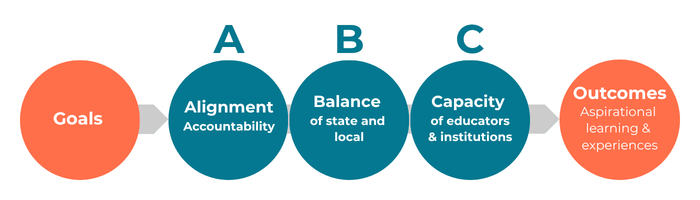
As explained in Ed100 Lesson 5.7, community schools expand the role of school sites bringing in services and expertise from community partners.

Ed100 Lesson 5.7
Community Schools
Examples include health services, tutoring, counseling, case management, or other supports to address local needs. Research has found that community schools can improve academic outcomes for historically underserved students. Building on those findings, the 2026-27 Budget Act provides $1 billion in ongoing funding. It expands the model to 3,700 additional school sites that have large concentrations of students from low-income families, English learners, and youth in foster care.
Literacy:

In the Ed100 blog:
How parents changed reading instruction in California
The budget makes a significant investment of $350 million for literacy coaches and reading specialists to help students become stronger readers.
Another $40 million is committed to universal screening for reading difficulties for K-2 students. This will help teachers identify struggling readers so they can support them more effectively.
Quick budget explainer
Each year, California’s state constitution requires the state budget to set aside money specifically for TK-14 education (that is, grades TK-12 and public community colleges). The protected funds, known as the Proposition 98 minimum guarantee, come to about 40% of the General Fund of the state budget. (See Ed100 Lesson 8.4.)
Most of the money in the Prop. 98 education budget goes to school districts through the Local Control Funding Formula (LCFF), explained in Ed100 Lesson 8.5. This money pays for operating costs like salaries for educators, administrators, and counselors in virtually all California public schools. Costs for transportation and building maintenance fall in this category, too.
To protect ongoing programs like public education from being eroded by inflation, each year the state calculates a cost-of-living adjustment (COLA) based on economic data. In the 2026-27 budget, the statutory COLA was 2.87%. The legislature allocated additional discretionary funds to create what has been called a “super COLA” of 4.31%. This additional funding is expected to cover the cost of a new (and unrelated) requirement: Beginning January 1, 2027, TK-14 local educational agencies must provide all employees with up to 14 weeks of paid pregnancy disability leave.
Even with these investments, the Proposition 98 budget for next year is slightly lower than in past years on an inflation-adjusted basis:
The budget also includes restricted money that must be spent on specific educational programs. These include, for example, American Indian programs, Child Nutrition, Foster Youth, Special Education and arts education.
|
California Education Budget 2026-27 — Key Numbers |
|
|---|---|
|
Prop. 98 minimum guarantee for TK-14 schools: |
2026-27: $128.1 billion 2025-26: $125.3 billion 2024-25: $124.9 billion Each Budget Act includes a three-year “window.” As conditions change, figures are revised. Relative to the 2025 Budget Act, the budget over the three-year window has increased by approximately $21.7 billion. |
|
Projected per-pupil spending, based on attendance assumptions in each budget: |
2026-27: $21,129 according to reporting by EdSource. (About $28,207 per student when all sources are included, according to California Today.) 2025-26: $18,671 2024-25: $18,399 2023-24: $17,678 |
|
LCFF funding including increase for cost of living (COLA) |
$86.2 billion $1.1 billion increase in discretionary funds over last year. $1.1 billion additional through a "super COLA," for a total (statutory plus discretionary) COLA of 4.31 percent. $31.3 million increase of Proposition 98 General Fund to provide a 20-percent increase in LCFF funding for Necessary Small Schools, which is the funding formula for the smallest schools in the state. |
|
Education Rainy Day Fund balance |
As required, the budget deposits $8.7 billion into the Public School System Stabilization Account (PSSSA), with an additional discretionary deposit of $500 million, for a total balance of $9.2 billion after 2026-27. |
|
Pre-School funding |
Budget changes the funding source for non-local educational agency State Preschool providers to Proposition 98 General Fund. This shifts $813 million from the General Fund to the Proposition 98 General Fund and increases the Proposition 98 Guarantee Test 1 percentage from 39.3 percent to 39.6 percent. |
Want even more nitty-gritty details? Revel in the entire education budget. (See page EDU-24 for the totals.)
A note of caution
Budgets are built on predictions. Will Californians actually earn income and pay taxes at the levels the state Department of Finance has predicted in the budget?
“The budget is overextended… at highs last seen at the peak of the dot-com bubble” —LAO
No one knows for certain. The state Department of Finance tracks key indicators monthly, relying on information like incoming taxes.
The state Legislative Analyst's Office (LAO), a nonpartisan agency independent from the Department of Finance, warns that the three years ahead could be rough sledding:
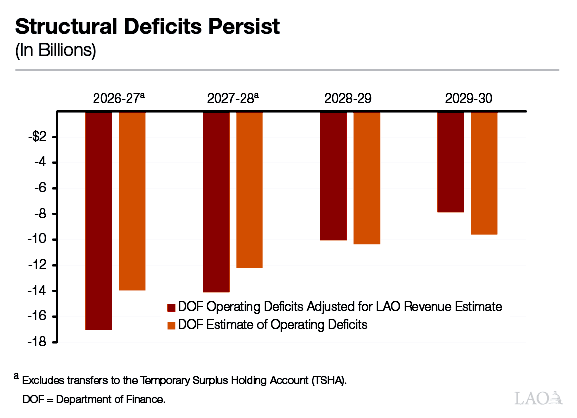
“The state’s current fiscal situation is genuinely unprecedented. Despite booming revenues, the budget position is overextended, reflecting: a structurally higher spending base, diminished reserves, an already accumulated wall of debt, and an operating deficit. Meanwhile, a revenue shock could be coming, as the state’s revenue outlook rests disproportionately on AI‑driven equity valuations that are trading at highs last seen at the peak of the dot‑com bubble.”
— California Legislative Analyst
Specific education investments
The budget contains significant investments that parents and communities have asked for. Ed100 lessons and blog posts linked below help explain the issues.
|
Education investments in the 2026-27 budget, by category |
|
|---|---|
|
Special Education |
Increase of $2.4 billion in special education funding plus: $80 million for the special education extraordinary cost pool $30 million for the Supporting Inclusive Practices Project $25 million for the Inclusive College Technical Assistance Center $10 million for alternative pathways and alternative means to a high school diploma for students with disabilities. Learn more: Special Education |
|
Professional development block grant |
$5 billion to address:
Learn more: How do teachers improve? |
|
Community Schools |
$1 billion in ongoing funds.
Learn more: Community Schools |
|
Teacher Preparation |
Three-quarters of a billion dollars in new investments to accelerate the state's progress in addressing teacher shortages:
Learn more: Teacher Development |
|
Literacy and math instruction |
$430 million in combined investments:
Learn more: |
|
Immigrant students |
$175 million in combined investments:
Learn more: Immigrant Students |
|
Early Education |
The budget extends investment in the youngest learners:
Learn more: Early Education |
|
Learning Recovery block grant |
The impacts of the pandemic linger. The budget directs $757.3 million to support schools to address pandemic-related learning setbacks. |
|
Kitchen Infrastructure and Training |
$500 million for specialized kitchen equipment, infrastructure, and training to support schools in providing more freshly prepared meals made with locally grown ingredients. Learn more: Healthy Food for Healthy Minds |
|
Homeless students |
$116 million to increase identification of and improve educational outcomes for students experiencing homelessness. Learn more: Homeless Students |
|
Dual enrollment |
$100 million Learn more: Dual Enrollment |
|
Reading Difficulties Risk Screening |
$40 million Learn more: It’s time to screen all students for reading challenges |
|
Holocaust and Genocide Education |
$10 million Learn more: How do kids learn about their country and the world? |
|
Maternity Leave |
Creates up to 14 weeks of paid pregnancy leave for employees of TK-12 schools and community college, funded by a 1.44% COLA. |
How does California pay for schools?
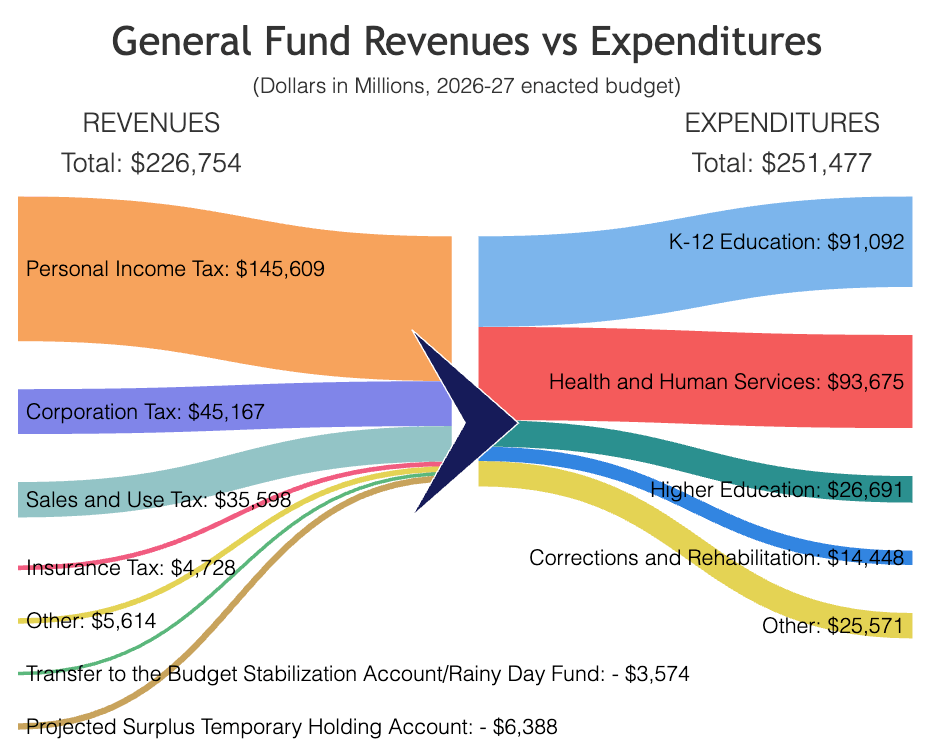
As explained in Ed100 Lesson 8.3, funding for public K-12 education in California comes from three main sources: state income taxes, local property taxes, and the federal budget, in that order. The portion from each source has varied over time.
State income taxes that go toward education are strongly influenced by the economy, the stock market, and the terms of Proposition 98. Property taxes that go toward education (and which are included in calculation of the Prop. 98 guarantee) were more or less set in stone by voters who passed Proposition 13 in 1978.
The schematic below, produced each year as part of the state budget process, helps make an important point: education is a one of the state government’s largest responsibilities. We pay taxes so that kids can learn.
Years of context
Ed100 has examined and explained the California education budget process for many years. Here are links to our prior writing on the subject. We like to think we are getting better at it. Let us know what would make these budget posts more useful to you.
|
Year |
Governor’s proposed budget |
Enacted budget |
|---|---|---|
|
2026-27 |
||
|
2025-26 |
(No post) |
|
|
2024-25 |
||
|
2023-24 |
||
|
2022-23 |
||
|
2021-22 |
Jeff Camp contributed to this post.
Tags on this post
BudgetsAll Tags
A-G requirements Absences Accountability Accreditation Achievement gap Administrators After school Algebra API Arts Assessment At-risk students Attendance Beacon links Bilingual education Bonds Brain Brown Act Budgets Bullying Burbank Business Career Carol Dweck Categorical funds Catholic schools Certification CHAMP Change Character Education Chart Charter schools Civics Class size CMOs Collective bargaining College Common core Community schools Contest Continuous Improvement Cost of education Counselors Creativity Crossword CSBA CTA Dashboard Data Dialogue District boundaries Districts Diversity Drawing DREAM Act Dyslexia EACH Early childhood Economic growth EdPrezi EdSource EdTech Education foundations Effort Election English learners Equity ESSA Ethnic studies Ethnic studies Evaluation rubric Expanded Learning Facilities Fake News Federal Federal policy Funding Gifted Grade inflation Graduation rates Grit Health Help Wanted History Home schools Homeless students Homework Hours of opportunity Humanities Independence Day Indignation Infrastructure Initiatives International Jargon Khan Academy Kindergarten LCAP LCFF Leaderboard Leadership Learning Litigation Lobbyists Local control Local funding Local governance Lottery Magnet schools Map Math Media Mental Health Mindfulness Mindset Motivation Myth Myths NAEP National comparisons NCLB Nutrition Pandemic Parcel taxes Parent Engagement Parent Leader Guide Parents peanut butter Pedagogy Pensions personalized Philanthropy PISA Planning Policy Politics population Poverty Preschool Prezi Private schools Prize Project-based learning Prop 13 Prop 98 Property taxes PTA Purpose of education puzzle Quality Race Rating Schools Reading Recruiting teachers Reform Religious education Religious schools Research Retaining teachers Rigor Rubrics School board School choice School Climate School Closures Science Serrano vs Priest Sex Ed Site Map Sleep Social-emotional learning Song Special ed Spending SPSA Standardized tests Standards Strike STRS Student motivation Student voice Success Suicide Summer Superintendent Suspensions Talent Taxes Teacher pay Teacher shortage Teachers Technology Technology in education Template Test scores Tests Time in school Time on task Trump Undocumented Unions Universal education Vaccination Values Vaping Video Volunteering Volunteers Vote Vouchers Winners Year in ReviewSharing is caring!
Password Reset
Search all lesson and blog content here.
Login with Email
We will send your Login Link to your email
address. Click on the link and you will be
logged into Ed100. No more passwords to
remember!









Questions & Comments
To comment or reply, please sign in .