



Getting Down to Facts about California's education system, 2026
Just the facts, California
On May 7, 2026, the SCALE initiative at Stanford announced the release of Getting Down to Facts III, a trove of new research about California's education systems. It wasn't a surprise — this is the third time that Stanford has played a central role in a coordinated research project like this. If history repeats, insights from this work will lead to significant changes in education policies in California and beyond.
Bookmark this post! We might deepen it over the coming weeks and months.
The project is huge. A team of 113 leading researchers, analysts and experts from across the country conducted the research, with findings published in 22 research briefs, supported by 55 technical reports across 11 themes. One epic summary brief by Stanford professor Susanna Loeb ties the work together. This role is familiar to Dr. Loeb, who has played a key role in every Getting Down to Facts (GDTF) project in the state's history (2007, 2018, 2026).
As in the past, the timing of this research intentionally coincides with a moment of anticipated change in state leadership. Whoever succeeds Gavin Newsom as governor will have extensive, fresh data upon which to base policy choices about education.
In the 11-minute video below, Dr. Loeb discusses the GDTF III project with John Fensterwald, the Editor at Large of EdSource:
Copy our concordance as a study guide
The Ed100 team will gradually incorporate findings from this research into lessons, blog posts, charts and tables over the coming weeks and months. As part of our process, we are developing a GDTF-Ed100 concordance to match Ed100 lessons with the research and policy briefs. Meanwhile, this post further condenses Dr. Loeb's summary, linking to parts that might be of use to Ed100 readers. As we explore at the end of this post, some very important research is easily overlooked!
Added: Watch brief summaries from the researchers (YouTube playlist).
Main themes of the GDTF III research
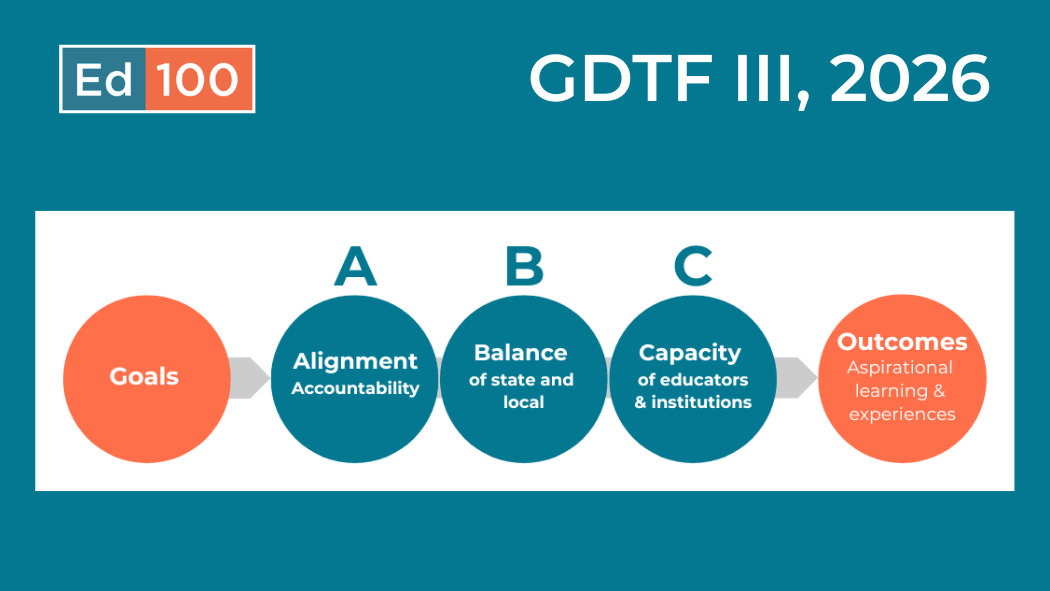
The dominant theory of change for this research project is that California’s education system as a whole can and should be greater than the sum of its parts. Thematically, Dr. Loeb and the research team describe their work as getting down to the ABCs that connect goals with outcomes:
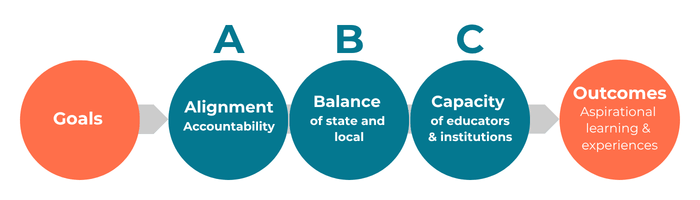
A is for Alignment and Accountability. As Dr. Loeb explains, "Accountability depends on being able to see patterns clearly, connect identification to response, and trace whether supports reach students in the form and intensity intended."
B is for Balance. California’s system relies on a combination of state and local systems to deliver results for each child.
C is for Capacity. Change happens when people know what to do and have the resources they need to do it. The studies recommend specific areas for improvement.
By design, research like this focuses on problems and shortcomings. It would be easy — and wrong — to come away with the impression that the system is hopeless, despite the authors’ efforts to remember the positives. For example, California’s approach to financial oversight of school systems has been so successful that the research hardly mentions it. The research draws on examples of success to highlight ways to make schools and systems work better.
A Alignment and Accountability
California's education system is complex because, as we point out in Ed100 Chapter 7, it has to be. California is tasked with serving each student, even in the face of massively varying needs and scarcities.
It’s a tall order, beyond the reach of the system as it exists today. According to Dr. Loeb, "California has the pieces of a coherent accountability system… California’s central challenge is whether it can connect its ambitions, policies, supports, and institutions into a system that delivers strong learning opportunities consistently.”
Glaring, growing gaps
A glaring finding of the GDTF III research is that achievement gaps — durable patterns of weak learning results associated with race/ethnicity, and income — have grown worse over time. California’s current system tends to deliver weak outcomes for the kids who need the most help. Gaps like these exist in all states, but in California the gaps are wider than elsewhere.
California’s education system is more decentralized than most states. It directs money and power to school districts, which receive state and local funding primarily through the Local Control Funding Formula (LCFF: see Ed100 Lesson 8.5). Except in charter schools, accountability for results under this system is so decentralized that it scarcely exists: local communities are supposed to notice problems and spur action as part of the annual budget process. Each year, districts produce a public three-year plan known as a Local Control Accountability Plan (LCAP: see Ed100 Lesson 7.10).
The 2026 research confirms what many suspected — LCAPs aren’t working well. The plans tend to be vague, toothless and little-read:
“When researchers examined more than 7,000 goals that California districts set through their Local Control Accountability Plans, the median measurability score was zero. Fewer than 8 percent of goals included explicit numeric targets, and more than 20 percent were duplicated verbatim across agencies. California’s formal goal-setting system often produces statements of intent that are weakly connected to measurable outcomes, clear strategies, or the conditions associated with student learning.”
— From the GDTFIII brief Goals for Students and Schools in California: Broad Aspirations, Uneven Translation into Practice by Antero Garcia, Stanford University
California’s data systems are meant to help coordinate teaching and learning across schools, grade levels and educators. The research findings emphasize that the systems, while improving, remain weak. This shortcoming is not news — it was a key finding of the second round of GDTFII studies in 2018. These studies helped lead to the development of the California School Dashboard, the state’s major accountability system for schools and districts. (See Ed100 Lesson 9.7)
It will surprise no one that the Dashboard hasn’t delivered magical results — many districts and county offices of education scrape the data and build their own way of viewing the data. The 2026 report, focusing on solutions, explores some ways to improve focus on student outcomes. Other states have tamed the complexity of their accountability reports in creative ways.
The research helpfully explores many other questions and issues related to alignment and accountability. Here’s a taste:
|
Some topics explored in GDTF III related to Accountability and Alignment (link) |
|
|---|---|
|
Fragmented governance |
Should more functions be concentrated in fewer entities? |
|
Fragmented data |
Should systems that collect data (e.g. LCAP, SARC) be connected or combined? |
|
Fragmented priorities |
Among the many things districts must do and report, which matter, to whom and when? |
|
Missing audiences |
Who is meant to read and understand these many reports, and who is meant to equip these audiences to make meaning of them? |
|
Tutoring for results |
Louisiana and Tennessee have made a difference with strong programs. What holds California back? |
|
Multilingual learners |
California is a latecomer to serving this segment. What can we learn from Texas and other states with more successful programs? |
B Balance
Power in California’s education system has alternated between centralization and local control. We are currently in a time of relatively decentralized policies — school districts don’t control over how much money they have to work with, but they have meaningful control over how they can use what they get, subject to local oversight.
The GDTF III research generally applauds California’s main system for allocating funds to districts. The Local Control Funding Formula (LCFF), explained in Ed100 Lesson 8.5, is a fair, explainable system — and a huge improvement over the messy, political system that preceded it.
Unfortunately, the research suggests that the system is out of balance. An important premise of a decentralized strategy is that educators and administrative leaders can deliver better results without minimal meddlesome oversight. In practice, this isn’t happening. At many levels, administrators and educators feel bound by processes and requirements of low value. For example, the studies reveal that administrators are buried in mandatory process work that typically consumes 20 hours per week or more.
In practice, the LCFF system has a lot of built-in rigidity, especially in upper grades. In her summary, Professor Loeb rattles off examples: [Ed100 links added]:
“The state regulates instructional minutes and seat time through an Average Daily Attendance system that is tied to auditing and to detailed rules for how time counts. These rules can make it harder for schools to use technology flexibly, incorporate experiential learning, or redesign schedules around more individualized or interdisciplinary models. State control is also strong in curriculum and course structure. The A-G system prescribes the courses that students must complete for university eligibility and reviews the content of those courses, which makes interdisciplinary design harder and can slow adaptation to new knowledge in fields such as math and science. Categorical funding rules further limit discretion by attaching separate requirements and audit risk to particular uses of funds.”
California has routinely under-performed other states in the work of teaching children to read. There are good reasons to expect improvement, because the state has shifted the balance, insisting that teachers receive instruction on effective practices that incorporate phonics in their teaching. Implementing this change, still underway, has required a multi-year effort. Districts are still rooting out demonstrably ineffective teaching materials, urging teachers to use better options.
The studies point specifically to two additional academic areas where students would probably be better served with stronger state guidance and somewhat less local control: curriculum for mathematics and multilingual education. In these areas, school boards and district leaders often lack the expertise to make well-informed choices among a sea of unclear options.
Over the last decade, California has gradually expanded its alphabet soup of early education programs, with universal Transitional Kindergarten now stapled firmly onto the front end of the K-12 sequence. There are many opportunities to make early education less of a Frankenstein add-on. Early education can have a huge beneficial impact on lifetime outcomes. GDTF III includes seven new studies in this category.
C Capacity
For decades, egregious lack of funding undermined public education in California. Districts simply lacked the financial capacity to hire enough teachers and other adults needed to operate adequate schools. Today, the GDTF III studies suggest California's system is no longer starving, but it remains distinctly lean and vulnerable:
“Despite significant improvement since 2012-13, as a share of state GDP, California’s K-12 school districts received less from state and local sources in 2022-23 than they did in 2007-08 prior to the Great Recession. California measured 3.4% on ELC’s effort index in 2007-08, 2.7% in 2012-13, and 3.3% in 2022-23.”
— From GDTF III technical brief #18, California Schools’ Revenue Sources and Constraints by Jonathan Kaplan and Efrain Mercado
As Ed100 explains in Lesson 8.2, money is only good for what it can buy. The GDTF III studies took a broad approach to evaluate the capacity of school systems to do their work, including the systems that prepare teachers, administrators and paraeducators. School systems chronically struggle to find enough teachers qualified to teach students with special education needs. Dr. Loeb writes, “Teacher shortages are perhaps most stark in special education, with three-quarters of new special education teachers entering the classroom without having completed teacher certification and then leaving quickly at higher rates.”
Improving school systems is difficult, sometimes disruptive work. By nature, some of the work has to happen and harmonize locally. Dr. Loeb cautions that “Districts rarely improve through state policy alone. They also need intermediary organizations that can interpret guidance, support implementation, and help sustain changes in practice across schools and systems.”
The GDTF III project itself exists independently of the education system, thanks to the contributions of nine funders. Community groups like site councils and PTAs will have roles to play in bringing research into practice.
California trails other states’ results in both multilingual education and mathematics, and the research doesn’t pull punches. By learning from examples of success, progress is possible.
Research findings and recommendations related to capacity-building should be of particular interest to readers in school communities because they involve tradeoffs and planning. Learning happens in the interactions among students and prepared adults — educators, staff, and parents. Doing it well requires planning, preparation, and coordination.
How to read GDTF III deeply
The best way to begin is with Susanna Loeb’s excellent summary. Footnotes in her summary refer by number to the 55 technical research papers associated with GDTF III. To quickly navigate to them, use this Ed100 GDTF Concordance of the research.
There’s a lot more beyond the ABCs.
If you inspect the concordance, you’ll notice that many of the studies expand to subjects beyond the ABC framework.
To pick one very important example, chronic under-funding of California’s teacher pension system consumes a huge fraction of the state’s education budget. Other states faced with this problem have shifted their approach, and the authors suggest that California should do the same:
“We review (a) the workforce incentives embedded in CalSTRS and (b) evidence on teacher preferences for DB pensions versus other forms of compensation. We conclude that the high cost of maintaining CalSTRS cannot be justified on these grounds.” [Emphasis added.]
— From GDTF III technical brief #19, Pensions and California Public Schools, 2026 by Cory Koedel and Sawyer Burgess
Additional themes that don’t fall cleanly into the ABC framework include these:
- Early Childhood Education
- Education Finance and Resources
- Family and Community Engagement
- Multilingual Learners
- Schools and Classrooms
- Special Education
- Student Learning and Wellbeing
- Technology and the Future
Advice for ambitious readers
If you are looking to tackle all of the GDTF content efficiently, begin with Dr. Loeb’s summary, then watch the short videos from the GDTF YouTube channel featuring the lead researchers — it’s nice to remember that real people did this work. Next, read the 22 research briefs, which present most of the recommendations and key findings prominently. Finally, dig into the 55 research papers.
I hope that this summary and the Ed100-GDTF Concordance will help you explore the research and draw inspiration from it. Why has the Getting Down to Facts project had such an important, beneficial influence on the development of California’s education system over time? Because people like you have taken the time to learn from it.
Again — the Ed100 team will gradually incorporate findings from this research into relevant Ed100 lessons, blog posts, charts and tables. Want to help? We want to hear from you!
Tags on this post
Change Policy Reform ResearchAll Tags
A-G requirements Absences Accountability Accreditation Achievement gap Administrators After school Algebra API Arts Assessment At-risk students Attendance Beacon links Bilingual education Bonds Brain Brown Act Budgets Bullying Burbank Business Career Carol Dweck Categorical funds Catholic schools Certification CHAMP Change Character Education Chart Charter schools Civics Class size CMOs Collective bargaining College Common core Community schools Contest Continuous Improvement Cost of education Counselors Creativity Crossword CSBA CTA Dashboard Data Dialogue District boundaries Districts Diversity Drawing DREAM Act Dyslexia EACH Early childhood Economic growth EdPrezi EdSource EdTech Education foundations Effort Election English learners Equity ESSA Ethnic studies Ethnic studies Evaluation rubric Expanded Learning Facilities Fake News Federal Federal policy Funding Gifted Grade inflation Graduation rates Grit Health Help Wanted History Home schools Homeless students Homework Hours of opportunity Humanities Independence Day Indignation Infrastructure Initiatives International Jargon Khan Academy Kindergarten LCAP LCFF Leaderboard Leadership Learning Litigation Lobbyists Local control Local funding Local governance Lottery Magnet schools Map Math Media Mental Health Mindfulness Mindset Motivation Myth Myths NAEP National comparisons NCLB Nutrition Pandemic Parcel taxes Parent Engagement Parent Leader Guide Parents peanut butter Pedagogy Pensions personalized Philanthropy PISA Planning Policy Politics population Poverty Preschool Prezi Private schools Prize Project-based learning Prop 13 Prop 98 Property taxes PTA Purpose of education puzzle Quality Race Rating Schools Reading Recruiting teachers Reform Religious education Religious schools Research Retaining teachers Rigor Rubrics School board School choice School Climate School Closures Science Serrano vs Priest Sex Ed Site Map Sleep Social-emotional learning Song Special ed Spending SPSA Standardized tests Standards Strike STRS Student motivation Student voice Success Suicide Summer Superintendent Suspensions Talent Taxes Teacher pay Teacher shortage Teachers Technology Technology in education Template Test scores Tests Time in school Time on task Trump Undocumented Unions Universal education Vaccination Values Vaping Video Volunteering Volunteers Vote Vouchers Winners Year in ReviewSharing is caring!
Password Reset
Search all lesson and blog content here.
Login with Email
We will send your Login Link to your email
address. Click on the link and you will be
logged into Ed100. No more passwords to
remember!








Questions & Comments
To comment or reply, please sign in .
Mary Perry May 12, 2026 at 8:35 am
Susanna Loeb May 12, 2026 at 8:22 am