



California's math education crisis

California’s students have gotten worse at math
Photo by Allison Shelley
The Verbatim Agency for EDUimages
First, the good news: Over time, California’s students are getting higher grades in math than they did in the past. That’s great, right?
Well, no — because here’s the bad news: The grades are inflated. California’s system of math education is a road to opportunity, but it has developed some serious potholes.
Every student deserves a solid education in mathematics, with support for those who struggle and challenge for those eager for more. This post explores California’s ongoing debate about math education, the role of standards and assessments, and what schools and school systems can do to turn things around so more teachers can help students learn what they need to know.
California’s not the only state with low math scores. It’s a national problem:
Excellence and equity in mathematics
California’s Mathematics Framework sets direction for how educators should teach math at each grade level. Revised by the State Board of Education in 2022, the framework provides specific guidance for educators and publishers about the sequencing of topics in mathematics and how to teach them:
- Plan teaching around big ideas
- Use open, engaging tasks
- Teach toward social justice
- Invite student questions and conjectures
- Prioritize reasoning and justification.
Prior to the revision, the previous framework (2013) emphasized specific mathematical content standards — discrete mathematical skills and concepts that students should learn. To be clear, these standards are still present in the 2022 framework, but the revision de-emphasized them in favor of teaching around big ideas.
The Math Wars
An emphasis on social justice was a prominent change to the framework, echoing educational debates prominent at the time of its development (circa 2020). The revision strongly reflects the views of its authors, especially Jo Boaler, an influential Stanford professor and a controversial voice in what has become known as the Math Wars.
In emphasizing the social justice implications of math education, San Francisco Unified (SFUSD), was an early leader. Influenced by Dr. Boaler’s ideas, the district reduced early tracking of students in the mid-2010s to keep them all on a common pathway longer. Specifically, the district removed the option of taking Algebra I in 8th grade. It was a big reversal from previous reforms that had called for the opposite: a push for algebra for all in 8th grade. Early studies seemed to show that the no-algebra policy had been effective, which had a big influence on the State Board’s decisions in 2022.
In public comments during the State Board’s deliberation process, a group of mathematicians, math educators, and practitioners published a joint letter to express their concerns about the framework. Specifically, they cautioned that it reduced clarity about preparing a pathway for students to pursue rigorous, college-level math.
Did the revision of the math framework produce better results? Specifically, did delaying some students from taking Algebra I lead to stronger overall results and narrow the achievement gap in math?
Alas, no. Subsequent research found that the policy didn’t produce the hoped-for results in student learning. In 2024 furious voters in San Francisco overwhelmingly demanded that middle school access to algebra be restored.
In 2026, as part of the studies known as Getting Down to Facts III, a squad of researchers sifted evidence from the policy of withholding algebra in 8th grade:
“Although the [achievement gap] narrowed, it did so largely by reducing access among more advantaged students rather than expanding access among those historically underrepresented. Students who complete advanced math courses continue to enroll in four-year colleges at substantially higher rates, with especially large returns for low-income students.”
Critics of the framework argue that the problem extends beyond course sequencing. Tom Loveless, an education policy expert with a critical view of the math framework, took particular aim at the way it dismissed the value of math fluency: “California’s proposed framework mentions the words “memorize” and “memorization” 27 times, but all in a negative or downplaying way.”
“Cognitive psychologists have long pointed out the value of automaticity with number facts—the ability to retrieve facts immediately from long-term memory without even thinking about them. Working memory is limited; long-term memory is vast. In that way, math facts are to math as phonics is to reading. If these facts are learned and stored in long-term memory, they can be retrieved effortlessly when the student is tackling more-complex cognitive tasks.”
What the data tell us
Unfortunately, indicators of student achievement have been moving in the wrong direction.
The National Assessment of Educational Progress (NAEP), often called the Nation’s Report Card, is one of the most trusted long-term measures of student learning. (See Ed100 Lesson 1.1.) NAEP scores in both math and reading have declined nationally in recent years, with especially large losses following the COVID-19 pandemic. California’s results reflect the same troubling pattern.
Could the scores be an illusion, reflecting something other than faltering results? It’s tempting to wish so, but the preponderance of evidence suggests otherwise. As explored in Ed100 Lesson 9.6, the uneven results of education show up in California’s state tests, too:
Why external tests matter
For decades, students, families, and educators have relied on shared signals of academic readiness. Course grades provided one signal. State assessments have provided another. For college-bound students, scores on some other tests came to matter a great deal, especially scores on the SAT and ACT tests. Because colleges paid attention to these exams, students and schools did too.
Colleges realized that SAT/ACT scores improved their ability to predict whether applicants would succeed in their classes if admitted. Unfortunately, scores on the tests also tended to reflect the racial/ethnic patterns shown in the chart above. Advocates argued that, in practice, the tests had an unfair impact on disadvantaged applicants. Following litigation and a settlement agreement in 2021, the University of California (UC) agreed to discontinue using them for decisions about admission. Other public colleges and universities, wary of becoming a target for litigation, followed the UC’s lead.
In 2026, hundreds of UC faculty, including department leaders, signed an open letter calling for the return of SAT/ACT testing for science, technology, engineering and mathematics applicants, expressing alarm that six years of test-free admissions had damaged student readiness. “We now observe preparation gaps so severe that instructors must reteach middle school mathematics,” the letter reads. “Obscuring preparation gaps harms both students individually and the University collectively.”
Meanwhile, many other states have gone the opposite way — embracing the SAT or ACT as a requirement for all 11th grade students. In these states, the SAT or ACT acts roughly as the equivalent of California’s high school CAASPP exams.
For decades, the College Board, the nonprofit company behind the SAT®, has had a massive influence on what a rigorous high school program includes. In each high school subject, its Advanced Placement (AP®) curriculum and associated tests essentially define college-ready learning. Every year more than 3 million students take one or more AP tests, receiving a grade from 1 to 5.
There are many AP-aligned courses, and they are exactingly designed. Many colleges regard earning a score of three or better on an AP test as college-creditable. At the top end of the high school math curriculum, at least, the goal posts are clear and accepted.
Debates about curriculum inevitably raise a practical question: How do we know whether students are learning more math?
The case for honest grades, earlier
The goal posts along the way, unfortunately, aren’t as clear, and they are often downplayed. As explained in Ed100 Lesson 1.5, most students don’t advance to college, but most parents think they will.

In the Ed100 blog
How my son finally learned his math facts
Wishful grading practices have removed signals about students’ progress in developing math skills, especially in elementary and middle grades, leaving parents under the impression that things are OK when they are not. This is bad, because it takes practice to develop math skills. It’s possible for parents to play a big supportive role in math practice, especially in early grades — but only if they know how to help.
What can we do, realistically? The challenge of building capacity
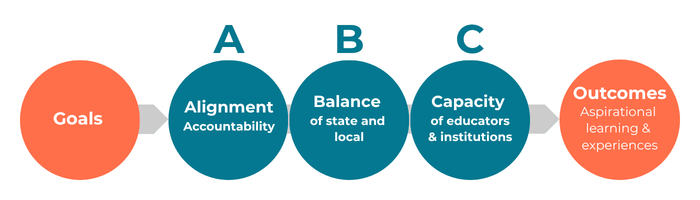
California’s weak math scores were an area of emphasis in Getting Down to Facts III, a much-anticipated collection of research released in 2026 about California’s education system and how to improve it. One major theme of the project was whether California’s education system has the capacity to improve student outcomes at scale. In the technical studies about math education in California, the system’s limited capacity was a core area of concern.
“Achievement gaps have widened in math while narrowing in reading, and math has received less consistent state and district attention than literacy,” writes Elizabeth Huffaker, one of the scholars on the project. “Districts lack the capacity to support strong math instruction.”
The research specifically calls for a stronger state role in identifying and selecting effective learning materials, with better training for teachers to use them.
The Mississippi math miracle
The state of Mississippi famously has become one of the nation’s most successful states at teaching economically disadvantaged students to read by focusing on phonics and teacher training over a decade of effort. Less famously, it also became a standout in math for the same students. The thing that connects these successes, also observed in Louisiana, may be attention to solid execution when implementing changes. Do more of what works, less of what doesn’t, and know the difference.
Math and the role of homework

In the Ed100 blog
The role of homework in learning
Mastering each topic in math requires effective practice — essentially, time spent with your brain turned on. Learning can be engaging and pleasurable, but it necessarily involves effort. Without it, we don’t really retain anything.
Few educators in history have influenced math instruction more broadly than Sal Khan, the creator of Khan Academy. When I want to sharpen a math skill or understand how to explain an operation, that’s where I go. Many math educators do the same. It’s not fancy — it’s just a set of clear, patient explanations with loads of practice problems.
It seems to me that districts and educators often overlook Khan Academy as a tool for helping students practice and learn. As of this writing in 2026, Khan Academy is wrestling to develop Khanmigo, an AI-assisted tool to help educators plan lessons and teach them.
By today’s media standards, Khan Academy videos are pretty dry — could students benefit from more sleekly produced material? Well, maybe. Dr. Derek Muller, the creator of Veritasium, a popular YouTube channel about math and science, argues that no platform or technology eliminates the connection between effort and learning. Learning that isn't effortful is forgettable. As psychologists say, easy come, easy go.
California’s math challenges are not mysterious. Students need strong materials, knowledgeable teachers, honest feedback, and enough time engaged in meaningful practice. None of these are easy to provide at scale. But the evidence increasingly suggests that lasting improvement depends on preparing teachers to help more students in the effortful work of learning mathematics well.
Tags on this post
MathAll Tags
A-G requirements Absences Accountability Accreditation Achievement gap Administrators After school Algebra API Arts Assessment At-risk students Attendance Beacon links Bilingual education Bonds Brain Brown Act Budgets Bullying Burbank Business Career Carol Dweck Categorical funds Catholic schools Certification CHAMP Change Character Education Chart Charter schools Civics Class size CMOs Collective bargaining College Common core Community schools Contest Continuous Improvement Cost of education Counselors Creativity Crossword CSBA CTA Dashboard Data Dialogue District boundaries Districts Diversity Drawing DREAM Act Dyslexia EACH Early childhood Economic growth EdPrezi EdSource EdTech Education foundations Effort Election English learners Equity ESSA Ethnic studies Ethnic studies Evaluation rubric Expanded Learning Facilities Fake News Federal Federal policy Funding Gifted Grade inflation Graduation rates Grit Health Help Wanted History Home schools Homeless students Homework Hours of opportunity Humanities Independence Day Indignation Infrastructure Initiatives International Jargon Khan Academy Kindergarten LCAP LCFF Leaderboard Leadership Learning Litigation Lobbyists Local control Local funding Local governance Lottery Magnet schools Map Math Media Mental Health Mindfulness Mindset Motivation Myth Myths NAEP National comparisons NCLB Nutrition Pandemic Parcel taxes Parent Engagement Parent Leader Guide Parents peanut butter Pedagogy Pensions personalized Philanthropy PISA Planning Policy Politics population Poverty Preschool Prezi Private schools Prize Project-based learning Prop 13 Prop 98 Property taxes PTA Purpose of education puzzle Quality Race Rating Schools Reading Recruiting teachers Reform Religious education Religious schools Research Retaining teachers Rigor Rubrics School board School choice School Climate School Closures Science Serrano vs Priest Sex Ed Site Map Sleep Social-emotional learning Song Special ed Spending SPSA Standardized tests Standards Strike STRS Student motivation Student voice Success Suicide Summer Superintendent Suspensions Talent Taxes Teacher pay Teacher shortage Teachers Technology Technology in education Template Test scores Tests Time in school Time on task Trump Undocumented Unions Universal education Vaccination Values Vaping Video Volunteering Volunteers Vote Vouchers Winners Year in ReviewSharing is caring!
Password Reset
Search all lesson and blog content here.
Login with Email
We will send your Login Link to your email
address. Click on the link and you will be
logged into Ed100. No more passwords to
remember!










Questions & Comments
To comment or reply, please sign in .
David de Leeuw June 17, 2026 at 5:15 pm