




Education starts with parents and families.
In This Lesson

How does early learning at home shape success?
What's the role of parents in reading?
What everyday habits help students succeed?
Why does attendance matter so much?
How should parents navigate the digital world?
How do families shape friendships and opportunities?
How do parents choose and understand schools?
How should parents work with teachers?
How can parents advocate for their children?
How can parents grow as learning partners?
How can parents get involved in schools?
What makes a school community effective?
Why do PTAs and parent groups matter?
▶ Watch the video summary
★ Discussion Guide
Long before a child enters a classroom, parents and caregivers shape how children learn, communicate, and respond to challenges. The role of families continues after school begins. Parents influence daily habits, expectations, friendships, use of technology, and how children experience school. They also play a vital role as partners and advocates, helping schools work better for their own children and for the broader community.
How does early learning at home shape success?
From the earliest months of life, children develop skills in language, attention, and social interaction through their experiences with caregivers. For babies and toddlers, every minute is learning time. The early years help shape how children communicate, how they approach challenges, and what they are ready to learn when they enter school.
It may seem obvious, but young children learn a lot through play, including how to focus, solve problems, and get along with others. Early educators are masters in the art of playful learning, and parents can learn to be positively playful, too.
States and foundations sporadically fund programs to offer instruction in how to be good parents. The programs can be effective, but governments do not routinely prioritize them, partly for bureaucratic reasons. Which agency ought to be responsible? If funded without new money, who are the winners and losers? For more about early learning, read Lesson 4.1.
Reading aloud together with children is deeply valuable. Decades of research show that children in more highly-educated families tend to get more reading time than those with less-educated parents:
The chart above, from the US Department of Education, shows longstanding gaps in family reading behavior, but it pre-dates the widespread intrusion of phones and screens as part of the experiences of childhood and parenthood. As of this update in March, 2026, research to update this chart has been delayed in the U.S., but it's easy to guess where it's headed. Based on data from the U.K., we should expect to see big declines in family reading.
This is concerning. Reading from books exposes kids to richer language than they experience in everyday speech or videos. The act of reading together — asking questions, pointing to pictures, and connecting stories to life — helps children become motivated readers. Organizations like Reach Out and Read and Reading Rockets offer practical ideas for families.
As we will explain further in Ed100 Lesson 2.7, many children find reading frustrating. Educators are trained to recognize the signs of learning disabilities; your job as a parent is to ensure that your child is screened for the risk of dyslexia so they can get the help they need to thrive.
What everyday habits help students succeed?
The role of parents evolves over time. Along the way, parents help set the tone for whether school feels important, manageable, and worth the effort. Day-to-day habits, expectations, and encouragement all shape how students experience school.

In the Ed100 blog
Homework: More Time on Task
Simple routines matter. Making sure children get enough sleep, having a regular time and place for homework, and keeping mornings predictable can help students stay focused and ready to learn.
Parents can play a big role in defining what matters. High expectations do not have to mean pressure for perfection. The true north is to help children develop and internalize character qualities and soft skills. For example, when kids do something wrong, a common parent instinct is to punish them, which can have unintended effects. Try going deeper. Ask whether a voice inside them knew it was wrong. Then ask what got in the way of listening to that voice. Then ask what would help make it right.
Parents can make a big difference in how their kids approach things they find difficult. Psychologists refer to this as favoring a growth mindset, but for personal reasons I prefer to think of it as a peanut butter mindset. Follow the link to learn why.
Why does attendance matter so much?
Success in school starts with showing up every day. When kids miss school, they fall behind. The resulting problems are cumulative — and contagious. Students can't benefit from instruction, participate in class, or build relationships at school if they aren't there.
Getting kids to school on time every day can be a logistical challenge for families. A pattern of failure can be a signal of deeper problems. Because truancy is a warning signal for child neglect, it can serve as a basis for a referral to Child Protective Services, a function of county governments. (More about this in Ed100 Lesson 2.8.)
During the COVID-19 pandemic, schools reported sharp increases in chronic absenteeism, which is defined as missing 10% or more of the school year to date. After the pandemic, attendance did not return to its previous levels, creating a crisis in lost learning for kids and lost funding for schools. Learn more about the importance of attendance in Ed100 Lesson 4.8.
How should parents help kids navigate the digital world?
Technology has become part of daily life, scrambling many educational practices and assumptions. Like adults, students increasingly use tech to do research, complete assignments, communicate with teachers, connect with peers… and waste a lot of time. Sweet distraction is always just a click away. Learning is important mental work, but it is work.
Under the California Phone Free Schools Act (2024), each California school district must have policies to limit or prohibit smartphone use. The aims of this law are to reduce distractions, curb cyberbullying, and improve mental health by minimizing screen time during school hours.
Outside of school hours, policies about phone usage are a family matter. Parents play an important role in helping children develop healthy habits in this fast-changing digital environment. The American Academy of Pediatrics offers guidance for families on managing media use. Many families turn to Common Sense Media for insights.
Technology isn't all bad, of course, and it's here to stay. As we explore in Ed100 Lesson 6.6, education technology (edtech) can also be a powerful tool for learning. Many schools use platforms such as Google Classroom or ParentSquare to share assignments, grades, and announcements. Staying connected through these tools helps parents stay informed and support their children’s progress.
How do families and friendships shape opportunities?
As children grow, their peers become an increasingly important influence. Friends can shape attitudes about school, behavior, and goals for the future. Parents can play a significant role in shaping or limiting the environment in which those relationships develop.
For many students, athletics and other extracurricular pursuits become an important source of identity and social connection. Participation in sports, clubs, arts programs, or community organizations can help students build positive relationships and develop new interests. In many school communities, these activities are thinly funded, leaving the vital work of social connection to YMCAs, churches and other groups.
California has invested billions, with fickle federal support, to support a system of after school programs. These programs can help kids with extra learning time, and they help provide parents some help during weekdays. Ed100 Lesson 4.7 explains more about it.
How do parents choose and understand schools?
One of the most important decisions families make is where their child goes to school. In California, where you live often determines the school your child attends.
Wherever you live in California, your address belongs to the geographical domain of one public school district. In that district, your kids have the right to attend school at no cost. If the district operates more than one public school serving your grade level, which school is yours? Districts have the power to answer that question, and they do so in different ways. You might also have the option to enroll in a public charter school, if one operates in your district and has open seats. School transfers are rarely permitted, but might be possible. It all starts with your address.
Ed100 Lesson 5.1 and Lesson 5.2 explain how school assignments work, and how school choice systems work. Lesson 5.5 explains charter schools.
How can parents improve as learning partners?
As children grow, their needs change and become more complex. Many parents struggle to keep up as the role evolves. It takes insight and practice to develop the knack for listening carefully, asking helpful questions, and responding constructively to setbacks. Some ideas that seem obvious in hindsight can be surprisingly powerful.
Resources exist to help parents develop the skills they need. For example, GreatSchools offers a huge collection of free, practical, research-based advice for parents at different stages. The Harvard Center on the Developing Child offers insights into how children learn and how adults can support healthy development.
Like any skill, parenting improves with reflection, experience, reading, and good advice at the right time. PTAs and other groups can help parents imagine ahead about what their kids will need from them as they advance from one developmental stage to the next. When students know that an adult is paying attention and ready to help, it helps them persist through challenges.
As kids grow up, they make mistakes. Parents make mistakes, too, but many can be avoided by learning ahead of time and practicing. Puberty is big change. How will you respond when your child asks for something you think is inappropriate for them? Perhaps just as important, how will you say it? (Personally, my personal favorite parenting hack is not to answer right away. It's OK for your child to know that you are thinking.)
How should parents work with teachers?
Teachers have mixed feelings about working with parents. On one hand, strong communication between home and school can make a meaningful difference in a child’s experience. On the other hand, parents are humans. They can be delightful and helpful, but they can also be distracting, demanding, or occasionally monstrous.
Schools and districts often establish policies about the kind of help they do and don't want from parents. Particularly in places where many parents want to be involved, administrators often look to PTAs or other parent groups for specific help.
Parent-teacher conferences can reinforce wishful thinking
Many schools schedule parent-teacher conferences once or twice a year. These meetings are an opportunity to learn about a child’s progress, ask questions, and share information that may help the teacher better understand the student. In many schools, these conferences include students, which can help build responsibility and ownership.
Sometimes, conversations between parents and schools can drift toward overly optimistic assumptions about how things are going. Ed100 Lesson 1.5 explores how wishful thinking can affect decision-making. Honest, specific conversations about progress and challenges are more useful than vague reassurance.

In the Ed100 blog
How do Schoolsite Councils work?
In each California public school, a Schoolsite Council meets monthly to advise the principal. These public meetings are a powerful way for parents and students to learn about the school, how decisions are made, and how to help at a systemic level. Anyone remotely interested in service on a school board should first attend site council meetings in their district. In schools where many students are learning English, parents are needed for service on English Language Advisory Councils (ELACs).
How can parents advocate for their children?
Schools are complex systems, and they do not automatically meet each student’s needs. When they don't, parents have to take action.
Advocacy can take many forms. It might be as simple or gentle as asking questions — How can you find help? Is there a program? What has worked for other kids?
Advocacy isn't just about formal processes. Parents can also advocate by staying informed, asking for clarification when needed, and following up on concerns. Keeping records of communication and being clear about goals can help make these efforts more effective.

In the Ed100 blog
How do PTAs work?
Parents can also work together to advocate for improvements. Through organizations like the California State PTA or local school committees, families can raise concerns and push for changes that benefit many students, not just their own.
For students with disabilities, advocacy is especially important. Federal law guarantees the right to a free appropriate public education (FAPE), and families are key participants in decisions about services and supports. But things don't necessarily happen automatically — you have to ask for them. Ed100 Lesson 2.7 explains how special education works and how parents can be involved in the process.
In 2023, parental rights became a politically-coded term. Some parents and political leaders used it in arguing that parents should have broad power to exclude their children from things that they disagree with. In particular, this term became connected to vaccination and to learning materials that challenge their beliefs. The flash points included sex education and teaching about gender identity. A post on Ed100 reviews the existing rights of parents under federal and state laws.
How can parents get more involved in schools?
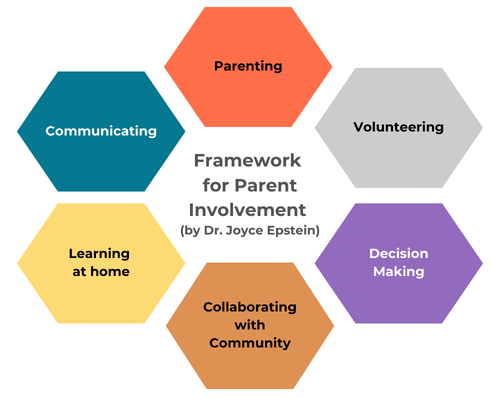
Parents can help shape what happens in schools and school communities. To help think through those roles, Dr. Joyce Epstein of Johns Hopkins developed a Framework for Parent Involvement, pictured here. We've already touched on several of the elements in this post. Below are some specifics for deeper engagement.
Volunteer. Many schools have a PTA or other parent group. Getting involved as a volunteer is a great way to understand your school's advantages and challenges. It's also a good way to meet the school principal and teacher leaders.
Attend site council meetings. Principals make many important school-level decisions in conversation with a site council, a small group that consists of parents, students and faculty, often including the local union representative. Meetings are public.
Connect with district leaders. Many crucial decisions are beyond the control of a principal or site council. In California, a great deal of authority lies with the school district, which is managed by the local superintendent of schools. If you want something changed that's beyond the power of your school principal, contacting the district office is the next step. If you can't find the right contact at the district office, ask your representative on the school board for advice.
Use the LCAP process. If your idea or concern will require significant change, it needs to become part of the district's formal plan. Each school district in California operates on a three-year Local Control Accountability Plan (LCAP) that must be adopted annually by the school board with review by the County Office of Education. You can learn much more about the process in Ed100 Lesson 7.10. Together with the California State PTA, Ed100 developed a LCAP parent checklist helps parents identify the most important needs at a school.
Don't bother the mayor. If you are trying to make changes in schools, it's usually a waste of time to appeal to the mayor or city council. As Ed100 Lesson 7.3 explains, they have little or no influence over schools, which are a separate arm of government.
The value of an engaged parent community

In the Ed100 blog
How to improve schools together with Ed100 Groups
Parents, students, and community members can bring tremendous value to school systems. Some step up to leadership roles — is that you? Preparing future leaders is central to the mission of Ed100. If you are serving in a leadership role, please consider forming an Ed100 Group to help others learn together. It's free.
It's easy to underestimate the importance of volunteers. Ed100 Lesson 8.11 — part of our chapter about funding for schools — estimates their value.
Is your school community doing a good job of engaging parents? The National PTA developed a scorecard to help school communities evaluate their current level of parent engagement, take action to expand it, and measure improvement over time. The scorecard includes six standards, based on Joyce Epstein’s model of parent engagement.
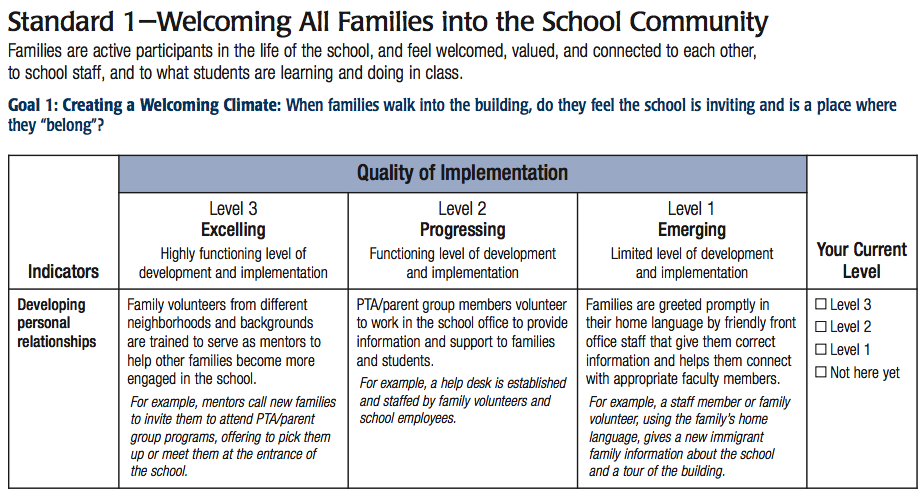 PTA National Standards for Family-School Partnerships Assessment Guide ©California State PTA
To help parents navigate their local school systems and become effective child advocates, the California State PTA operates parent academies called School Smarts. School districts that have used the program reported that it helped parents feel comfortable and informed to participate in school decision-making.
Updated March 2026
Quiz×
CHAPTER 2:
Students...
-
Students...
Overview of Chapter 2 -
Diversity
The Changing Face of America's Students -
Poverty and Race
How Do Students' Backgrounds Affect Their School Performance? -
Health and Education
What Can Schools Do? -
The Role of Parents
Education and Families -
How Does Education Change
Inputs and Outcomes -
Motivation
What Motivates Students? -
Special Education
Why Not Teach All Kids Alike? -
Child Protection
Intervention and foster care -
Undocumented Students
Education vs. Documentation -
Student Leadership
Student Voice in Schools
Related
Sharing is caring!
Password Reset
Search all lesson and blog content here.
Login with Email
We will send your Login Link to your email
address. Click on the link and you will be
logged into Ed100. No more passwords to
remember!










Questions & Comments
To comment or reply, please sign in .
Carol Kocivar October 30, 2025 at 2:19 pm
[Reported in EdWeek] David Gundale, the principal of Open World Learning Community, a public magnet school in St. Paul, Minn., serving grades 6-12, says between 85% to 100% of parents routinely show up for twice-a-year conferences. What’s the secret? The parent-teacher conferences are led by the students.
“The participation level is over twice the amount of a traditional parent check-in with teachers,” said Gundale. “The big difference is that the [traditional] conferences are adult to adult versus the student at the center of things.”
Carol Kocivar June 15, 2022 at 7:20 am
Selisa Loeza October 22, 2021 at 7:13 pm
Carol Kocivar October 8, 2021 at 5:03 pm
A. The efforts the school district makes to seek parent input in making decisions for the school district and each individual school site;
B. How the school district will promote parental participation in programs for unduplicated pupils; and
C. How the school district will promote parental participation in programs for individuals with exceptional needs.
amy su November 5, 2020 at 8:43 pm
Jeff Camp November 15, 2018 at 3:58 pm
"How is family engagement different? Parent involvement generally refers to the
participation of parents in programs and activities that have been planned or
designed by school personnel, such as volunteering in a classroom or
chaperoning on a field trip. By contrast, parent engagement denotes the active
participation in informing decisions about LEA priorities and planning actions
to achieve them. "
francisco molina August 13, 2019 at 1:52 am
nkbird July 27, 2018 at 4:54 pm
nkbird July 27, 2018 at 4:51 pm
Caryn September 10, 2018 at 9:48 am
Sonya Hendren September 10, 2018 at 1:27 pm
Carol Kocivar June 18, 2018 at 8:21 am
Read about these findings
Susannah Baxendale January 11, 2019 at 1:45 pm
Mickey J June 12, 2018 at 3:09 pm
Alma Cacho May 2, 2018 at 9:42 am
jacquelinebispo May 2, 2018 at 5:57 am
Carol Kocivar March 3, 2018 at 5:54 pm
RESEARCH STORIES Harvard Graduate School of Education
The Brain-Changing Power of Conversation
"Interplay between parents and children ignites the brain and boosts its response to language, spurring lasting literacy skills."
Read the article
Lisette October 3, 2017 at 1:40 pm
Carol Kocivar September 19, 2017 at 2:19 pm
Spanish
jacquelinebispo May 2, 2018 at 9:14 am
Alma Cacho May 2, 2018 at 9:44 am
Jeff Camp - Founder July 15, 2017 at 1:13 am
David Siegrist1 April 30, 2017 at 11:59 am
Albert Stroberg May 1, 2016 at 5:59 pm
susan_m_mathews May 20, 2015 at 4:03 pm
Jeff Camp - Founder May 21, 2015 at 3:23 pm
David Siegrist1 April 30, 2017 at 12:00 pm
shadowzwench April 27, 2015 at 12:20 pm
Paigey Girl April 22, 2015 at 2:19 pm
harplits March 13, 2015 at 7:29 am
Tara Massengill April 19, 2015 at 11:14 am
Jenny N September 28, 2015 at 5:00 pm
jenzteam February 27, 2015 at 9:25 am
geecookie2011 April 18, 2015 at 7:27 am
Brandi Galasso February 9, 2015 at 10:51 am
anamendozasantiago February 5, 2015 at 7:58 pm
David Siegrist1 April 30, 2017 at 12:02 pm
anahsrad January 12, 2015 at 10:33 pm
Jeff Camp - Founder January 13, 2015 at 9:22 am
Jeff Camp - Founder November 12, 2014 at 9:24 am
Paul Muench October 31, 2014 at 7:51 pm
I think having a growth mindset is the most important thing a parent can "do" for his children's education. Working day after day with no apparent change can be frustrating. But somehow learning seems to work that way. It seems as if a person needs time for all the pieces of understanding to align and become solid and then all of a sudden he can perform. So much of learning is "invisible" to a parent that faith and patience is necessary to help your child become somebody new. Having a growth mindset can seem a false prophesy at first, but that's only because it's really a self-fulfilling prophesy. Telling parents its real, its genuine, you can believe in it is a great first step.
Arati N June 19, 2014 at 2:03 pm
David Siegrist1 April 30, 2017 at 12:03 pm