



A brief history of public education
School should be free and mandatory for all kids. It's obvious, right?
Actually, it's kind of a new idea.
In This Lesson

What is a public school?
What is a Blaine Amendment?
What is the history of public schools?
How did we put children in schools 100 years ago?
When did school become mandatory in America?
What was the Keating-Owen Act?
When did the school lunch program start?
What is the Elementary and Secondary Education Act (ESEA)?
How did Sputnik affect education in America?
How did "A Nation at Risk" change education?
What was the standards movement?
What was No Child Left Behind?
What was Race to the Top?
How has COVID-19 changed education?
▶ Watch the video summary
★ Discussion Guide.
This lesson summarizes major milestones in the history of public education in the United States. This history matters because public education has changed dramatically over time, and its work remains unfinished. In general, the mission of public education in America has expanded, overcoming resistance, to include more students and take on greater responsibilities.
Access to education
At the time of America's founding, education was a scarce privilege, and universal education was beyond imagination. Accordingly, the U.S. Constitution does not mention public education. Like many aspects of American life, it is a matter left to the states under the 10th Amendment.
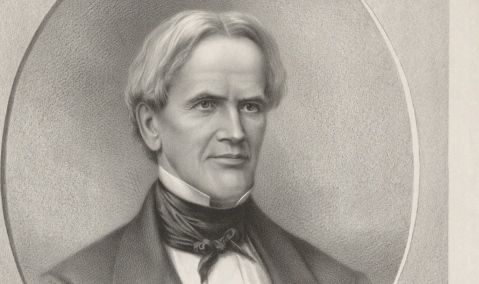
Large-scale public education in America began in Massachusetts in the 1850s, strongly influenced by the leadership of Horace Mann (pictured above). Mann helped build a system of more than a thousand schools modeled on the Prussian system of common schools.
Public education expanded partly as a response to widespread concern about the growth of Catholic schools. In 1875, President Ulysses S. Grant campaigned for a constitutional amendment to mandate free public schools and prohibit public funding of religious schools. This amendment (known as the Blaine Amendment) failed, but the policy was adopted in most state constitutions, including California's. Over time, the idea that public schools should be free, tax-funded, universally available, and independent from religious institutions became woven the fabric of America.
Free public education and the end of child labor
Tuition-free basic education expanded gradually. It was a big transition. In 1910, more than a quarter of children in America did not attend school. At the time, the idea of universal, tuition-free education was easy to dismiss as idealistic dreaming.
Tuition-free basic education has been universal in America for more than 100 years.
Still, putting children in school was an attractive alternative to child labor in fields and factories, where the poorest endured horrifying conditions with few protections. Around the turn of the 20th century, American journalists drew attention to the dreadful working conditions in factories. Women organized in protest, collaborating with the labor movement to press for policy changes.
By 1916 most states, following examples in Europe and Massachusetts, had passed laws to outlaw, discourage, or at least regulate child labor. As states developed laws regarding child labor, they also changed expectations about public schooling.
Milestones in the history of universal education
Over time, a broad theme in the evolution of public education has been to make access to it more universal.
|
Milestones in the history of public education |
|
|---|---|
|
Establish the idea of public schools |
In the 1850s, Horace Mann popularized the idea of public schools in America, inspired by schools in Prussia. |
|
Make school mandatory |
In 1910, a quarter of America’s children did not attend school. By 1918, Mississippi became the final state to legally require school attendance through the elementary grades. |
|
Reduce child labor |
The Keating-Owen Act of 1916 set federal standards for the maximum number of hours children could work, and banned interstate trade in goods manufactured by children. This measure was overturned by the Supreme Court in 1918, but momentum to reduce child labor continued to build. |
|
Feed kids so they can learn |
In 1946 Congress began funding for a nationwide school lunch program, helping schools address hunger and establishing a federal role in supporting students. |
|
Include kids of all races in schools |
In 1954, the Supreme Court ruled unanimously in Brown v. Board of Education that schools could not be segregated by race. |
|
Target funding to poor communities |
In 1965, President Lyndon B. Johnson signed the Elementary and Secondary Education Act (ESEA) as a key element of his War on Poverty. Title I of this Act provided federal funding to support education in low-income communities. The ESEA law evolved over time, becoming the No Child Left Behind Act (NCLB) under President Bush and then the Every Student Succeeds Act (ESSA) under President Obama. |
|
Include girls in schools |
In 1972, Congress amended the Higher Education Act of 1965, adding Title IX to prohibit discrimination on the basis of sex against students in federally funded schools. (It’s pronounced “title nine.”) |
|
Include students with disabilities |
In 1975 the US Congress established that American schools must provide a free and appropriate education to students with disabilities. This became known as the Individuals with Disabilities Education Act (IDEA). |
|
Include kids without documentation |
In 1982, the Supreme Court ruled that states cannot deny children access to education based on their immigration status. |
|
Make schools work online |
In 2020, the COVID-19 pandemic prompted school systems across the world to incorporate online learning. In California, for the first time virtually all students were provided with devices and network access for online learning. |
|
Incorporate AI |
In 2023, the rapid spread of tools such as ChatGPT pushed schools to confront the growing role of artificial intelligence in education. |
Each of the milestones above expanded education to more students. Taken together, these milestones mark a triumph of vision and commitment over inaction and resistance. Public schools have served as the central stage for difficult, contested changes in society. The story of universal public education in America is an unfinished chapter in the story of making equality real.
State and national education policies have increasingly reflected the principle that all students should have access to not just a nearby school, but a good school. Students must also have equal opportunity to succeed at school: they are protected from discrimination in the classroom.
A century of steadily expanding and improving access to education fundamentally changed America, both economically and socially. Universal public education has long been central to America's self-image as a land of opportunity.
Education is a strategy for national strength
National security concerns have strongly influenced the history of education systems throughout the world. Education has long been connected to national strength, but the meaning of strength has evolved.

Sputnik
In the early years of the Cold War, some U.S. leaders emphasized the importance of education as a way to resist communism. The Soviet Union's launch of Sputnik, the first satellite, sparked concern that America was falling behind. The country needed scientists and inventors for a nuclear age. This sparked a wave of investment in science programs in America's schools and universities. Today, it is widely accepted that education serves not only economic and military goals, but social ones as well.
Two generations later, the role of education in forming a strong democratic society was central to the core argument of A Nation at Risk, a 1983 report that called for sweeping changes in U.S. education. The report helped kick off a series of national conversations about standards. The goal was to improve what all children know and are able to do at each grade level so the U.S. could stay safe and competitive in a global economy.
A widespread consensus led to passage of the federal No Child Left Behind Act (NCLB) in 2001. The big-picture goal of NCLB was to gradually raise the achievement bar, year by year, so that all children, including those usually “left behind,” would receive a solid education. The law required each state to establish grade-level standards and to test all students annually in order to expose achievement gaps and evaluate each school’s success in the work of closing them.
As the bar rose, many schools fell short of expectations, especially for their students living in poverty or learning English. Popular support for the law collapsed. In 2015, a bipartisan consensus in Congress replaced NCLB with the Every Student Succeeds Act (ESSA), which kept the requirement for annual testing but with dramatically reduced accountability for results. ESSA significantly reduced the federal pressure on districts to close achievement gaps.
The United States has long imagined itself as a nation of immigrants — a “melting pot” where people of diverse backgrounds become American. Language is a central factor in identity, and in California about two-fifths of students speak a language other than English at home. For many years (from 1998 to 2016) California law required schools to conduct classes in English. Today, schools are expanding the availability of multi-lingual education.
These changes reflected an evolving understanding about the connection between public education and national strength.
Education is a strategy for lifting up all states
NCLB revealed that the 50 states expected widely different things from their students. Many states' standards had been written clumsily, with a narrow definition of success. In 2009, the National Governors Association launched a project to define a shared set of standards that became known as the Common Core State Standards. (More about that in Lesson 6.1.)
These standards originated with the states, but federal funding was key to their adoption. The Obama administration used a competitive federal matching grant program called Race to the Top to challenge states to develop strong implementation plans. California set 2015 as the year it would begin evaluating the performance of its students and schools based on these new standards.
How the pandemic changed education
In 2020, the COVID-19 pandemic suddenly changed education for virtually all students, accelerating the use of technology in classrooms and homes, and disrupting the expectation that students should attend school in person every day. Even years later, attendance levels remained lower than before the pandemic.
Public education in America operates through statewide systems of local schools, with critical help from the federal government to make the system fairer and allow local schools to weather hard times. During the pandemic, the federal government contributed significant temporary support to school systems.
Education is a bipartisan issue
Most of the world has reached a rough consensus that a broadly educated public is worth investing in. In America, public schools in every community depend on the shared support of Democrats and Republicans. This consensus is essential because universal public education costs serious money, which in turn requires significant taxes. As discussed in Lesson 1.1, most nations commit about 3% to 5% of their economy to public education through high school. In the United States, states commit resources to public in a similar range. California falls on the low-effort end of this spectrum, but 3% of the economy is a substantial commitment.
Reasons for hope
People disagree about public education policies. Disagreements simmer about charter school policies, for example, or the role of unions, or how much to spend, or how much to teach teens about sex.
But these noisy arguments all take place in the context of agreement so profound that we hardly notice it. We argue much less about the basic principle that all children should have the chance to attend quality schools and meet high academic standards. Horace Mann would be pleased.
This post was updated in July 2026
Quiz×
CHAPTER 1:
Education is…
-
Education is…
Overview of Chapter 1 -
California Education
Are California’s Schools Really Behind? -
American Education
Are U.S. Schools Behind the World? -
Education, AI, and the Economy
Schools for Knowledge Work -
Educational Failure
The High Social Costs of Bad Apples -
Grade Inflation
Wishful Thinking and Cognitive Bias -
Are Schools Improving?
Progress in Education -
History of Education
How have Schools Changed Over Time? -
Purpose of Education
What are Schools For, Really?
Related
-
Purpose of Education
What are Schools For, Really? -
Grade-Level Standards
What is the Common Core? -
STEM Education in California
Science, Technology, Engineering and Math -
Why Are Tests Important?
Why Tests Matter and How They Work -
Financial Literacy in California
Learning to Earn -
Should the Education System be Blown Up?
Would Disruption Help?
Sharing is caring!
Password Reset
Search all lesson and blog content here.
Login with Email
We will send your Login Link to your email
address. Click on the link and you will be
logged into Ed100. No more passwords to
remember!










Questions & Comments
To comment or reply, please sign in .
Sara Wolfe September 1, 2025 at 5:16 pm
Eliza Sauer January 29, 2020 at 7:00 am
Caryn January 30, 2020 at 9:23 am
Caryn January 30, 2020 at 9:26 am
francisco molina August 13, 2019 at 12:22 am
Jeff Camp July 4, 2018 at 11:46 am
Sonya Hendren September 6, 2018 at 2:32 am
Carol Kocivar July 14, 2016 at 8:39 pm
This report, requested by the Civil Rights Act of 1964, documents the availability of equal educational opportunities in public schools for minority students. http://files.eric.ed.gov/fulltext/ED012275.pdf
Education Week takes a look at then and now
http://www.edweek.org/ew/section/multimedia/50-years-seeking-educational-equality-the-coleman-report.html?cmp=eml-enl-eu-news1-RM
arienneadamcikova April 20, 2015 at 10:22 pm
Jeff Camp - Founder April 20, 2015 at 11:23 pm
Alice Griesemer March 23, 2015 at 5:49 am
What are we fighting about?
In 1850... All children should go to school.
In 1960... All children should go to a good school.
In 2000... All children should go to a good school and achieve at a standard level.
I wonder when we will be able to claim victory on the current debate and what the next one will be.
Veli Waller April 2, 2015 at 12:26 pm
Jeff Camp - Founder April 2, 2015 at 2:17 pm
anamendozasantiago February 11, 2015 at 5:24 pm
These students after years of neglect from our education system get so tired they begin looking elsewhere for challenges. It is a great loss for our society, state and country when we lose one of these talented minds to an educational system that is not meant to serve them.
"In the wake of sputnik, some educational programs were created to identify and support the education of children identified as the 'Best and Brightest.' These programs are mostly gone now."
Kim April 9, 2016 at 6:41 pm
celia4pta September 25, 2014 at 9:26 pm
RTTT did reward states for adopting internationally benchmarked standards, and CCSS were the easiest way to do this, but the initiative for the writing of the standards came from the National Governors Association.
Celia
Jeff Camp - Founder October 2, 2014 at 12:17 pm
--Jeff