



How California ballot initiatives shape schools and taxes

California’s voter initiatives: Power to the people
For more than a century, California’s state constitution has empowered citizens to bypass the formal legislative process through initiatives. With enough valid signatures, California voters can directly place measures on the ballot to change or create laws, and even change the constitution itself.
The initiative process was enshrined in the California Constitution in 1911 under then-governor Hiram Johnson.
Some of the most significant laws affecting education were passed this way.
|
Key voter initiatives that shaped California’s education system |
||
|---|---|---|
|
Proposition |
Impact |
Learn more |
|
Shifted the main source of education funding from local property taxes to statewide personal income taxes. |
||
|
Unintentionally undermined state collection of data from schools and districts |
||
|
Established a minimum guaranteed level of funding for public education in the state budget. (About 40 per cent of revenues from the state general fund) |
||
|
Reduced the threshold to pass a local school bond from two-thirds of voters to 55% of voters. |
||
|
Provides funding for after school programs. |
||
|
Allows languages other than English in public educational instruction. With this initiative, the voters of 2016 overturned the voters of 1998, who in Prop 227 (1998) had required instruction in English only. |
||
|
Provides funding for K-14 education with taxes on California highest incomes, extending Prop 30 (2012). |
||
|
Provides dedicated funding for arts education. |
||
In election years, initiative frenzy hits its high point in the spring. That’s because an initiative must gather enough signatures to be qualified by the Secretary of State on the 131st day before a statewide general election.

Ed100 Lesson 7.6
Ballot initiatives and education
Count backward from November and you can see why so many paid signature gatherers are smiling sweetly and asking you to sign a petition. The Secretary of State provides suggested deadlines to qualify for the November ballot.
Getting on the ballot is not easy and it's not cheap. Below is the average cost of statewide initiatives in California in 2024 as well as the cost per required signature (CPRS) according to data from Ballotpedia:
|
In 2024, how much did it cost to gather enough signatures to get an initiative on the ballot? |
|
|---|---|
|
Total average signature costs |
$8,463,664 |
|
Average cost per registered signature |
$15.08 |
The number of required signatures is based on the turnout at the last Governor’s election. In 2026, the number needed is 546,651 for a new law (5 per cent of the last vote) and 874,641 for a Constitutional Amendment (8 per cent of the last vote).
Each year, many proposals begin the trek to the ballot. Most of them have a snowball’s chance of getting through the process.
Many battles over taxes
There are many initiative proposals in the works in 2026. It’s possible that this year could be another milestone in the history of how California’s voters shaped the state’s education system.
In true Ed100 fashion, we take a look at three significant issues (across four proposed initiatives) that matter for education and give you some perspective on them. As of this writing, three of these measures haven’t yet been assigned numbers. If approved, the others will be assigned a number — even if the number has been used in prior years. (For example, there have been many Proposition 13s over the years — the one that matters to most people is Proposition 13 of 1978.)
In this post, we look at three important issues:
- Should California make permanent the existing 2012 voter-approved tax rates for high-income Californians?
- Should California fund private and religious schools?
- How easy or hard should it be to pass a tax initiative?
1 Sustain funding for public education
One proposition is certain to make the ballot: a measure to extend existing taxes for education that voters put in place in 2012 and renewed in 2016. A coalition of major education-related organizations and unions will work to ensure that the public understands the stakes, with active help from the California Teachers Association (CTA).
Click image to view a multi-page presentation about the initiative.
|
Official key facts and resources |
|
|---|---|
|
Title Initiative Constitutional Amendment |
“Provides permanent funding for schools and healthcare by extending existing tax on high incomes.” |
|
Summary from Attorney General |
|
|
Fiscal Impact |
Read background from the California Legislative Analyst. |
|
Full Text |
|
|
Signatures required |
874,641 |
Ed100 summary
In years when the economy is strong and the stock market is growing, the top 2 percent of California taxpayers pay about half of all state income taxes, which are the largest revenue source for public education in the state. As with the existing policy, most of the education-related money in this initiative goes to K-12 schools and community colleges. Following the pattern of Proposition 98, about 89% of anticipated revenue will go to K-12 schools. Local school boards decide how the revenues are spent, but may not use them to pay for administrative costs.
Ed100 bottom line
If this measure fails, it will blow a big hole in every public school’s budget, triggering cuts to schools, children's healthcare, and other essential services. School districts throughout the state are already struggling to meet students' needs for a variety of reasons, including chronic absences, the high costs of special education and health benefits, and the high cost of living in California. Making this tax ongoing, rather than temporary, reflects consistent needs of schools. The loss of an estimated $5 billion to $15 billion in annual revenue would be devastating to students and educators.
Learn more:
Ten ways to improve school attendanceThe funding squeeze behind California’s teacher strikes
2 Redirect funds to private and religious schools
Public education in California is funded by taxes. A small percentage of families, at their own expense, forgo public education and enroll their child at a religious school or other private school. This measure would amend the state constitution, redirecting public tax revenue to pay for private education.

Click to view website promoting the initiative
|
Official key facts and resources |
|
|---|---|
|
Title Initiative Constitutional Amendment and statute |
“Requires state provide annual payments to students attending religious and other private schools.” |
|
Summary from Attorney General |
|
|
Fiscal Impact |
Read background from the California Legislative Analyst. |
|
Full Text |
|
|
Signatures required |
874,641 |
Ed100 summary
According to the summary by the state Attorney General, the proposed initiative “requires the state to deposit yearly voucher payments ($17,000 initially, adjusted annually) into Education Savings Accounts for California residents in grades TK-12 attending religious and other private schools anywhere in the United States.”
The sponsors of the initiative object to the use of the word “voucher” in the description of their proposed program. California voters have soundly rejected past proposals to fund religious and private education using voucher mechanisms, and the sponsors do not use that term in describing their measure. Under the proposal, deposits would come from General Fund and property tax revenues that currently fund public schools.
Among the significant provisions of the proposal, it “eliminates constitutional prohibition on state funding of religious and other private schools”, "prohibits state regulation of private school curriculum”, and “prohibits building, safety, or health standards for home schools that are stricter than standards applied to homes or similar businesses.”
The office of the state non-partisan Legislative Analyst (LAO) estimates that the proposal would lead to “increased costs, likely ranging from several billion dollars to more than $10 billion per year, primarily driven by payments for students enrolled in private schools (or homeschooling). The state could pay for these costs using revenues it currently spends on public schools or other state programs.”
Additionally, the LAO estimates that the proposal would lead to reductions in state funding because some would leave public schools. “This reduction could range from a few billion dollars to more than $16 billion per year and is separate from any reduction the state might make to pay for its own costs. Public schools would likely respond by spending less on staff, supplies, services, and other activities.”
Ed100 bottom line:
This proposed initiative presents its core idea as “Education Savings Accounts” for students. In practice, it is similar to religious and private school voucher programs that California voters have rejected twice before: Prop. 174 (1993) and Prop. 38 (2000). Another ballot attempt in 2022 was withdrawn. Rebranding the proposal and tweaking the payment mechanisms doesn’t change the core impact: it would subsidize religious and private schools, redirecting tax revenue away from public education.
There are better policy options to provide families with expanded school choices.
Learn more:
Ed100 blog: Vouchers: A Dangerous Choice?
Ed100 blog: Religion and Public Schools
The Century Foundation: A Backdoor School Voucher Scheme
How easy – or hard – should it be to raise taxes?
There will probably be two dueling choices on the 2026 ballot
California’s constitution blends representative democracy (elected officials propose and pass measures) with direct democracy (voters propose and pass them). Under California’s constitution, voters have broad constitutional power to place measures on ballots — including the state ballot. In 2021, the state Supreme Court ruled that such citizen initiatives can pass with a majority vote.
This is an important change in understanding. According to a summary from Justicia (emphasis and links added):
“Proposition 13 and Proposition 218 require that any special tax adopted by a local government entity take effect only if approved by a two-thirds vote of the electorate. The court of appeal has recently interpreted these constitutional provisions ‘as coexisting with, not displacing, the people’s power to enact initiatives by majority vote’ and held that a measure placed on the ballot as a local citizens’ initiative requires a majority, not a supermajority, vote to pass.”
A ballot fight over this issue could have a big impact on local funding of schools as well as for other local services provided by cities and other local authorities. Voters might be faced with at least two conflicting measures on the November ballot, one sponsored by anti-tax groups and the other referred to voters by the legislature.
Let’s take a look at what’s brewing. (Read Ed100 blog California Supreme Court grants a wish to school communities for a full analysis.)
3A Let a majority raise the bar to 2/3
Click image to view website promoting the initiative
|
Official key facts and resources |
|
|---|---|
|
Title Initiative Constitutional Amendment |
“Limits ability of voters to raise revenues for local government services.” |
|
Summary from Attorney General |
|
|
Fiscal Impact |
Read background from the California Legislative Analyst. |
|
Full Text |
|
|
Signatures required |
874,641 |
Ed100 summary
This proposed initiative aims to eliminate or constrain the capacity for communities to fund schools and other local agencies through direct democracy. Under this measure, a majority would not suffice:
“Limits voters’ ability to pass voter-proposed local special taxes by raising the vote approval threshold requirement for such ballot measures from a simple majority (over 50%) to two-thirds.”
According to the LAO, passage of this initiative would result in lost revenues to local governments totaling up to a couple of billion dollars annually, predominantly affecting certain charter cities. “Potential future reduction in what local governments would otherwise collect in revenues due to a higher vote threshold for certain taxes and fewer types of taxes that local governments can adopt.”
Ed100 bottom line:
This initiative would make it significantly harder for communities to fund local services through voter-approved taxation. It is a contradictory standard for a majority vote to suffice for creating a requirement that requires a supermajority.
Read on for another alternative, ACA 13 (2026), that aims to resolve the contradiction.
3B Only a supermajority can require a supermajority
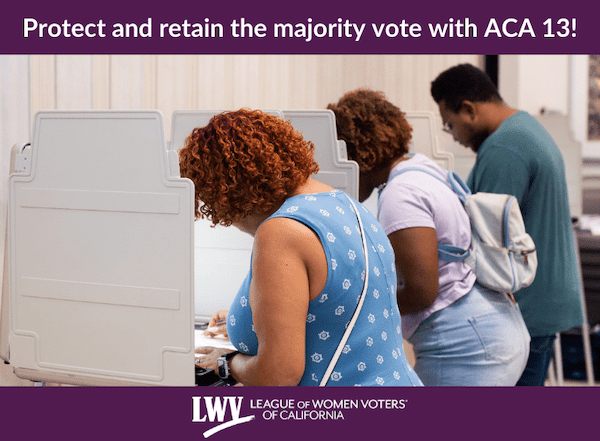
Click to view website
|
Official key facts and resources |
|
|---|---|
|
ACA 13 (2026) Assembly Constitutional Amendment |
Requires an initiative constitutional amendment to comply with any increased voter approval threshold that it seeks to impose on future ballot measures. Guarantees in the state constitution the ability of local governments to submit advisory questions to voters. |
|
Legislative analysis |
Read the Assembly Floor Analysis |
|
Fiscal Impact |
Read the Assembly Floor Analysis |
|
Full Text |
|
|
Signatures required |
None. The legislature has already placed this measure on the ballot. It will require a majority to pass. |
Ed100 Summary
In anticipation of an initiative like the one described above, the California legislature has crafted an alternative and qualified it for the ballot for November, 2026.
The measure provides that “an initiative measure that includes one or more provisions that would amend the Constitution to increase the voter approval requirement can be approved by the voters only if the proportion of votes cast in favor of the initiative measure is equal to or greater than the highest voter approval requirement that the initiative measure would impose.”
A measure can set a higher bar — if it can pass it.
That is, a measure can’t set a bar higher than it can pass. Want to set the pass requirement to 55%? You need a vote of at least 55% to set the bar. Want to set it to two-thirds, like Proposition 13 (1978)? You need at least two-thirds of voters to agree to it. Historical note: In 1978, Proposition 13 passed with almost ⅔ of the vote.
The measure applies only to voter approval thresholds, not other legislation: “This applies only to initiatives that seek to make it more difficult for voters to take action by approving a ballot measure. It does not affect the vote requirement for initiative constitutional amendments that seek only to make it harder for a governmental body to approve an action by increasing the vote by which that body must approve an action.”
The Ed100 bottom line:
There’s an inherent unfairness in a system that sets a different rule for future voters than today’s voters can muster. ACA 13 protects the democratic process at the state level and in local communities by setting the bars consistently. It ensures that a simple majority of voters cannot disenfranchise future voters.
What happens next?
California’s initiative system gives voters unusual power — not just to choose leaders, but to write the rules that shape schools and taxes. That power comes with tradeoffs. Initiatives can solve problems that lawmakers avoid, but they can also lock in decisions that are hard to change.
As the 2026 ballot takes shape, the stakes are real. The outcomes will influence funding, priorities, and opportunities for students across California. Understanding the choices is the first step toward making them wisely.
Tags on this post
Election Parcel taxes Prop 13 VouchersAll Tags
A-G requirements Absences Accountability Accreditation Achievement gap Administrators After school Algebra API Arts Assessment At-risk students Attendance Beacon links Bilingual education Bonds Brain Brown Act Budgets Bullying Burbank Business Career Carol Dweck Categorical funds Catholic schools Certification CHAMP Change Character Education Chart Charter schools Civics Class size CMOs Collective bargaining College Common core Community schools Contest Continuous Improvement Cost of education Counselors Creativity Crossword CSBA CTA Dashboard Data Dialogue District boundaries Districts Diversity Drawing DREAM Act Dyslexia EACH Early childhood Economic growth EdPrezi EdSource EdTech Education foundations Effort Election English learners Equity ESSA Ethnic studies Ethnic studies Evaluation rubric Expanded Learning Facilities Fake News Federal Federal policy Funding Gifted Grade inflation Graduation rates Grit Health Help Wanted History Home schools Homeless students Homework Hours of opportunity Humanities Independence Day Indignation Infrastructure Initiatives International Jargon Khan Academy Kindergarten LCAP LCFF Leaderboard Leadership Learning Litigation Lobbyists Local control Local funding Local governance Lottery Magnet schools Map Math Media Mental Health Mindfulness Mindset Motivation Myth Myths NAEP National comparisons NCLB Nutrition Pandemic Parcel taxes Parent Engagement Parent Leader Guide Parents peanut butter Pedagogy Pensions personalized Philanthropy PISA Planning Policy Politics population Poverty Preschool Prezi Private schools Prize Project-based learning Prop 13 Prop 98 Property taxes PTA Purpose of education puzzle Quality Race Rating Schools Reading Recruiting teachers Reform Religious education Religious schools Research Retaining teachers Rigor Rubrics School board School choice School Climate School Closures Science Serrano vs Priest Sex Ed Site Map Sleep Social-emotional learning Song Special ed Spending SPSA Standardized tests Standards Strike STRS Student motivation Student voice Success Suicide Summer Superintendent Suspensions Talent Taxes Teacher pay Teacher shortage Teachers Technology Technology in education Template Test scores Tests Time in school Time on task Trump Undocumented Unions Universal education Vaccination Values Vaping Video Volunteering Volunteers Vote Vouchers Winners Year in ReviewSharing is caring!
Password Reset
Search all lesson and blog content here.
Login with Email
We will send your Login Link to your email
address. Click on the link and you will be
logged into Ed100. No more passwords to
remember!










Questions & Comments
To comment or reply, please sign in .