



Ten ways to improve school attendance

What is chronic absenteeism, and how can schools fix it?
Chronic absence is a crisis undermining the education of nearly one out of five students in California. It's a problem that spiked in the pandemic and remains serious.

Hedy Chang is CEO and Founder of Attendance Works
Why care about chronic absences?
A lot of kids in California are missing a lot of school. It's a big deal! Chronically absent students struggle to do well in school. Schools lose money they need to pay teachers and staff. Even kids who show up regularly are affected by the disruption.
The good news is that when schools, families, and community partners work together, they can find out why students are missing school, develop solutions, and improve their school finances.
This post explains the challenge and offers ten solutions. But first, some context.
Absenteeism hurts students and families
Chronic absence is defined as missing at least 10% of school, for any reason. When young students miss this much school, they are less likely to read proficiently by the end of third grade, a major risk indicator for a variety of bad long-term outcomes.
The risks can linger: students who are chronically absent are less likely to achieve in middle school, and less likely graduate from high school. With less opportunity to connect to peers and adults, chronic absence undermines their ability to develop socially and emotionally. It makes students less likely to develop the executive functioning skills they need to succeed in life and the workplace.
Less-obvious effects of missing school
Sadly, chronic absence is corrosive for all students, not just those who are missing. When multiple students are chronically absent, the churn in the classroom makes it harder for teachers to teach and set classroom norms and for students to complete group projects. In a study of school attendance and outcomes after the pandemic, California students in schools with higher levels of chronic absence had worse achievement in math and science when compared to these scores in the 2018-19 school year.
During the pandemic, rates of chronic absence more than tripled, and they remained elevated years later:
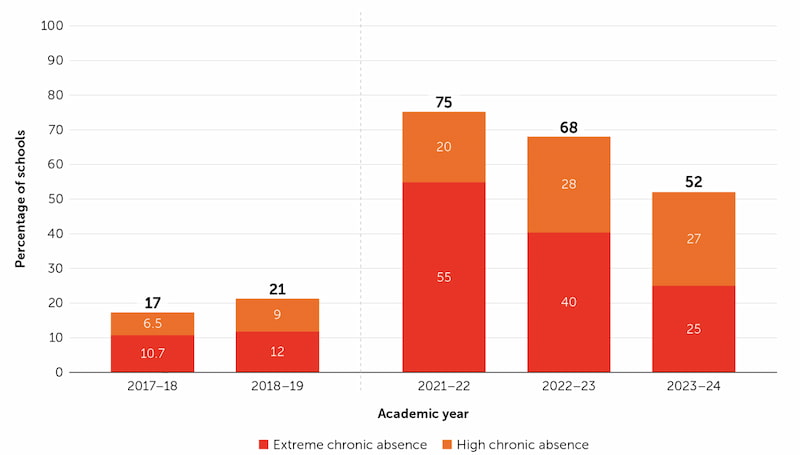
The percent of schools in California with a high chronic absence rate (20-29% of students) and extreme rate (30% or more of students). Source: PACE: Unpacking California's Chronic Absence Crisis
When students miss school, it makes it harder for parents and caregivers to show up to work in person. If parents are working virtually, having children at home makes it harder for them to focus on their job.
Why schools invest in attendance
In California, education funding is based on attendance. For every day a student attends school, their district receives funding of about $80 (as of 2024), most of which goes to pay for the salaries and health care of teachers and staff in schools.
The cost of absences adds up. For example, in the 2024–25 school year alone, San Francisco Unified School District students lost an estimated 4.4 million hours of learning and SFUSD lost over $60 million in funding for teachers and staff due to student absences.
In addition to lost funding, chronic absences raise costs by creating additional needs for tutoring, counseling, and remediation. The California Learning Resource Network estimates that schools lose between 22-30% of instructional time due to chronic absence.
Practical advice to improve attendance
The good news is that chronic absence can be reduced when schools partner with students and their families and caregivers, as well as the broader community. This article offers practical tips for how families can work with your principal, school staff, fellow parents and community partners to improve attendance.
First, find out the facts.
PTAs and other parent groups take the lead in this effort by working with both the school administration and parents to create a welcoming, supportive school environment for all students and families.
1 Examine your own children’s attendance.
How much school have they missed for any reason? It is all too easy for absences add up to missing 10% of school, or for students to miss just two days every month. Often this information is available on a parent portal. You can also ask your children’s teachers about your children’s attendance and how you can help them make up for the learning opportunities if they miss school.
2 Check for chronic absence at your school.
Go to the California Department of Education’s DataQuest portal to find out the percent and number of students who were chronically absent in your school or district. Attendance Works developed a step by step guide to help navigate DataQuest.
3 Find out who is leading.
Ask your principal which team (or staff person) is responsible for improving attendance. Ideally every school has a team responsible for organizing a comprehensive approach to promote attendance and engagement, using data to offer additional support when needed. Share this handout from Attendance Works on how to develop an effective attendance team.
4 Use data to learn from what works.
Ask your district if the data shows schools that are recording higher attendance rates than schools with similar student populations. Encourage them to reach out to the school to find out why. These schools can help offer insights and inspiration to others. Use this guide to help explore these success stories.
5 Engage students and families in understanding attendance barriers and solutions.
The key to improving attendance is finding out what causes each student to miss school in the first place. What are the barriers to being in school every day? Knowing the specifics can help lead to solutions that can motivate showing up even when conditions are challenging. Here are some tools that can help your principal and school staff:
- Empathy interview template and video
- Relationship building 2x2
- Student focus groups
- Attendance Cafe
- Student surveys
- Shadowing a student
6 Develop a positive school climate.
When students like school, they are more likely to overcome obstacles. Help your school identify strengths and opportunities that contribute to student attendance, including school climate, culture, and the physical environment.
Below are two comprehensive assessments that can be carried out by a team of staff and parents. Share them with your school administration. Armed with information that influences attendance, schools can take actions to address some of the causes, not just the symptoms, of chronic absence.
- Grades K-5 (Elementary): Tool and User Guide
- Grades 6-12 (Middle and High): Tool and User Guide
7 Promote effective, positive communication, not blame.
Look at the notifications your school or district sends out to inform students and families that they have missed too much school or have been truant. Give feedback to your school.
- Are families asked to verify the data?
- Does the communication express concern for the student’s well-being?
- Does it offer resources and support?
- Is it easy to understand?
Help your school set up two-way communication between families and the school or with teachers. This guide from Harvard offers tips on creating a texting program: Improve Attendance with Personalized Messages
California used to require districts to warn parents that they could face criminal penalties for failing to get their kids to school. At the urging of the California state PTA, this law was dropped in 2025 because research shows that a positive approach is effective in addressing truancy.
Make sure your school and district know about this sample first notice of truancy letter. It’s written using a positive approach, not blaming.
8 Encourage your school to support immigrant families.

Research shows that current operations by the federal Immigration and Customs Enforcement agency (ICE) have caused many immigrant families to fear sending their children to school. This approach undermines attendance. The National PTA has produced materials to help communities build trust and support.
For example, some school personnel are implementing a “walking school bus.” School staff and volunteers wear vests and carry signs as identifiers, and deploy to certain neighborhood blocks to walk with kids to school. If there’s an ICE agent present, the adults would be able to respond to them and take the kids inside.
California State PTA has developed additional advice regarding immigration enforcement near schools, available in English and Spanish.
9 Make attendance part of your PTA activities
PTAs can play a critical role in creating a school culture that can help reduce chronic absences. Schools with the strongest family engagement experienced six percentage points less chronic absence post-pandemic than schools with the least family engagement.
Use the National PTA Assessment Guide to rate how well your school supports family engagement and set goals. Other tips include:
- Discuss the importance of attendance at your parent meetings.
- Share practical strategies with families to reduce common struggles such as students not getting enough sleep due to excessive time on devices.
- Ask school staff to share their efforts to make your school a welcoming place for all parents and caregivers.
- Ensure the school provides supportive attendance information in communications with parents.
10 Use the tools available
All parents want their children to do well but many may underestimate how many days of school their children are missing, don’t recognize the adverse impact or can’t find resources to help them overcome barriers. Share these fliers from Attendance Works with your school community to help parents understand the importance of good attendance.
Encourage fellow parents to:
- Find out about their children’s absences, and use the Attendance Works Student Success Plans to get their children to school on time every day.
- Ask their children’s teachers what their children are learning this year. Ask how your children are doing in school, and find out the areas they may be struggling in. Make a plan for what you can do at home. The Learning Heroes tool can help.
- Attend school-sponsored meetings and participate in school activities to show your commitment to your children’s education.
Hedy Chang is the CEO, president and founder of Attendance Works, the nation’s go-to resource for attendance policy and practice. She has spent over three decades working in the fields of family support, family economic success, education and child development. She served as a senior program officer at the Evelyn and Walter Haas Jr. Fund and as co-director of California Tomorrow. Hedy earned her a Master’s degree in Public Policy from the Kennedy School of Government at Harvard University and her B.A. from Occidental College. In 2024, the National Association of State Boards of Education named her as the Policy Leader of the Year.Carol Kocivar is a frequent writer and editor of Ed100, and a past President of the California State PTA.
Tags on this post
Attendance Funding Parent EngagementAll Tags
A-G requirements Absences Accountability Accreditation Achievement gap Administrators After school Algebra API Arts Assessment At-risk students Attendance Beacon links Bilingual education Bonds Brain Brown Act Budgets Bullying Burbank Business Career Carol Dweck Categorical funds Catholic schools Certification CHAMP Change Character Education Chart Charter schools Civics Class size CMOs Collective bargaining College Common core Community schools Contest Continuous Improvement Cost of education Counselors Creativity Crossword CSBA CTA Dashboard Data Dialogue District boundaries Districts Diversity Drawing DREAM Act Dyslexia EACH Early childhood Economic growth EdPrezi EdSource EdTech Education foundations Effort Election English learners Equity ESSA Ethnic studies Ethnic studies Evaluation rubric Expanded Learning Facilities Fake News Federal Federal policy Funding Gifted Grade inflation Graduation rates Grit Health Help Wanted History Home schools Homeless students Homework Hours of opportunity Humanities Independence Day Indignation Infrastructure Initiatives International Jargon Khan Academy Kindergarten LCAP LCFF Leaderboard Leadership Learning Litigation Lobbyists Local control Local funding Local governance Lottery Magnet schools Map Math Media Mental Health Mindfulness Mindset Motivation Myth Myths NAEP National comparisons NCLB Nutrition Pandemic Parcel taxes Parent Engagement Parent Leader Guide Parents peanut butter Pedagogy Pensions personalized Philanthropy PISA Planning Policy Politics population Poverty Preschool Prezi Private schools Prize Project-based learning Prop 13 Prop 98 Property taxes PTA Purpose of education puzzle Quality Race Rating Schools Reading Recruiting teachers Reform Religious education Religious schools Research Retaining teachers Rigor Rubrics School board School choice School Climate School Closures Science Serrano vs Priest Sex Ed Site Map Sleep Social-emotional learning Song Special ed Spending SPSA Standardized tests Standards Strike STRS Student motivation Student voice Success Suicide Summer Superintendent Suspensions Talent Taxes Teacher pay Teacher shortage Teachers Technology Technology in education Template Test scores Tests Time in school Time on task Trump Undocumented Unions Universal education Vaccination Values Vaping Video Volunteering Volunteers Vote Vouchers Winners Year in ReviewSharing is caring!
Password Reset
Search all lesson and blog content here.
Login with Email
We will send your Login Link to your email
address. Click on the link and you will be
logged into Ed100. No more passwords to
remember!










Questions & Comments
To comment or reply, please sign in .
Jeff Camp - Founder February 4, 2026 at 12:19 pm