



Kids, Healthy Teeth, and School

Healthy teeth help kids in school
Cavities are the most common health condition afflicting children — even more common than asthma and obesity. Improving children’s oral health can keep them in school and help them concentrate on learning and playing.
In This Post
How do cavities form and what prevents them?
Does fluoride help keep kids’ teeth healthy?
Do California kids have healthy teeth?
What is the Kindergarten Oral Health Assessment?
Are children taught about oral health in school?
What can schools do to help?
When children are suffering from a toothache, it’s difficult for them to chew, talk, and even sleep. Children with poor oral health are nearly three times more likely to miss school than their healthier peers. It can also be socially isolating if a child doesn’t feel confident in their smile or breath because of problems with their teeth.
There’s money at stake too. In California, oral health problems are a top reason for student absenteeism and a drag on school finances, resulting in lost revenue of $60 million in 2022-23.

Eileen Espejo
Chilren Now
Parent organizations can do a lot to head off this preventable suffering and waste. This post summarizes what you need to know and suggests actions you can take to do something about it in your school community.
How do cavities form and what prevents them?
Tooth enamel is hard, but bacteria produce acid that can weaken it. This can eventually lead to a hole in the tooth, known as a cavity.
Cavities actually start as something known as “dental caries,” which are weaknesses in the enamel. These are largely preventable through practicing good hygiene, limiting sugar, and preventive practices and services such as community water fluoridation and topical fluoride varnish. Regular brushing and flossing can also help keep teeth and gums healthy by removing accumulated plaque.
Does fluoride help keep kids’ teeth healthy?
Yes. Fluoride is part of naturally occurring minerals that harden tooth enamel. Fluoride varnish, applied to teeth with a small brush, has proven to help strengthen teeth and keep cavities from progressing or forming. According to the California Dental Association, community water fluoridation — the practice of adding fluoride to community drinking water — is the single most cost-effective, equitable, and safe public health measure to prevent tooth decay and improve oral health. The Centers for Disease Control have recognized fluoride in drinking water as one of the 20th century's greatest achievements in public health.
Some detractors of community water fluoridation cite studies that suggest a cause between it and lower student IQ. These studies were conducted in countries outside of the United States with more than twice the level of recommended fluoride in the water system (optimal community water fluoridation is defined as having 0.7 mg/L of fluoride in water, with ongoing monitoring to ensure correct levels). The most recent National Toxicology Program study concluded “there were insufficient data to determine if the low fluoride level of 0.7 mg/L currently recommended for U.S. community water supplies has a negative effect on children’s IQ.” See additional research.
Do California kids have healthy teeth?
Unfortunately, California is trending in the wrong direction for young children with cavities.
While the national target for children ages 3 to 5 with cavities is 30%, California comes in at 53.6%. National surveys consistently have ranked the state among the bottom of the 50 states and D.C. — at one point 47th out of 51. A 2019 Smile Survey conducted by the California State Office of Oral Health found 61% of third grade students had cavities, with almost 1 out of 5 children screened having untreated tooth decay. In California, kids can qualify for free or low-cost dental care through Medi-Cal, a program known as Smile California.
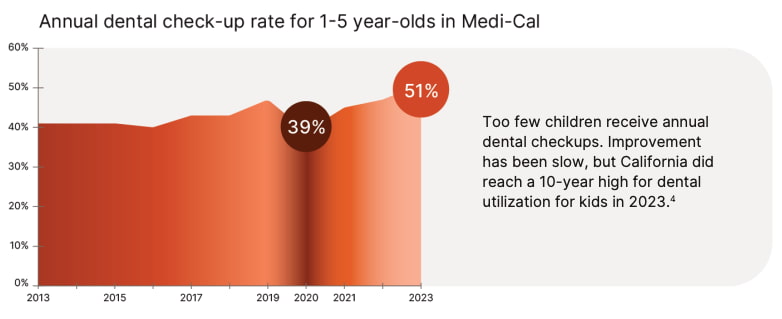
A major factor in this high rate of cavities is that among children up to age 5, less than half of those enrolled in Medi-Cal have been seen by a dental provider (i.e., a dentist or a hygienist) who can screen the child’s teeth and provide preventive treatments such as fluoride varnish.
What is the Kindergarten Oral Health Assessment?
When each child enrolls in the public school system for the first time, current law requires a Kindergarten Oral Health Assessment (KOHA), a form completed by a licensed dental professional regarding their oral health status. Non-identifying data is then submitted to the county office of education and eventually shared with the state dental director in the California Department of Public Health.
New audits are expected
Unfortunately, compliance with KOHA has been extremely low. Among the notable barriers are parents unable to find a dental provider and schools not having sufficient funding to dedicate staff to enter the data. In 2025, however, the Joint Committee on Legislative Audit approved the California State Auditor to audit KOHA to identify barriers and issue policy recommendations to increase compliance.
Are children taught about the importance of oral health in school?
Teaching oral health hygiene, especially to younger students, remains a critical opportunity given that good habits start early and all students should enter school ready to learn.
To help better teach kids the importance of oral health, local oral health programs (LOHPs) based in county health departments currently work to bring services to where students are, through school-based screening and referral programs. LOHPs have oral health advisory committees composed of county staff, community-based organizations, local dental societies, and sometimes school nurses and other personnel.
What can schools do to help?
Good oral health habits and behaviors start early, and there are many actions schools can take to help promote children’s oral health:
- Highlight the importance of children’s oral health by including it in school wellness policies.
- Help lower-income families apply for Medi-Cal and complete the form for access to free or low-cost dental care.
- Measure participation in the Kindergarten Oral Health Assessment at your school.
- Coordinate dental screenings and preventive services with your county’s local oral health program.
- Support National Children’s Dental Health Month in February by featuring lessons on oral health hygiene. Bring in a local dental provider to provide demonstrations and materials such as toothbrushes and toothpaste!
We encourage you to share this post with your school partners, as well as get involved with your oral health advisory committees to contribute your expertise and improve students’ oral health outcomes.
Eileen Espejo is the Senior Managing Director for Health at Children Now, a non-profit organization focused on the well-being of kids. She has served as a leader and member of national, state, and local advisory boards, including the National Oral Health Progress & Equity Network (OPEN), the California Oral Health Advisory Partnership, and as chair of the San Mateo County Oral Health Coalition and several local oral health advisory committees. Prior to working for Children Now, Eileen served as Director of Youth Governance for the Youth Leadership Institute in the Bay Area, as Legislative Affairs Associate at the Corporation for National and Community Service in Washington, DC and was a Coro Fellow in Public Affairs. She graduated cum laude from the University of California, Davis with a B.S. in Applied Behavioral Sciences.
Tags on this post
Health ParentsAll Tags
A-G requirements Absences Accountability Accreditation Achievement gap Administrators After school Algebra API Arts Assessment At-risk students Attendance Beacon links Bilingual education Bonds Brain Brown Act Budgets Bullying Burbank Business Career Carol Dweck Categorical funds Catholic schools Certification CHAMP Change Character Education Chart Charter schools Civics Class size CMOs Collective bargaining College Common core Community schools Contest Continuous Improvement Cost of education Counselors Creativity Crossword CSBA CTA Dashboard Data Dialogue District boundaries Districts Diversity Drawing DREAM Act Dyslexia EACH Early childhood Economic growth EdPrezi EdSource EdTech Education foundations Effort Election English learners Equity ESSA Ethnic studies Ethnic studies Evaluation rubric Expanded Learning Facilities Fake News Federal Federal policy Funding Gifted Grade inflation Graduation rates Grit Health Help Wanted History Home schools Homeless students Homework Hours of opportunity Humanities Independence Day Indignation Infrastructure Initiatives International Jargon Khan Academy Kindergarten LCAP LCFF Leaderboard Leadership Learning Litigation Lobbyists Local control Local funding Local governance Lottery Magnet schools Map Math Media Mental Health Mindfulness Mindset Motivation Myth Myths NAEP National comparisons NCLB Nutrition Pandemic Parcel taxes Parent Engagement Parent Leader Guide Parents peanut butter Pedagogy Pensions personalized Philanthropy PISA Planning Policy Politics population Poverty Preschool Prezi Private schools Prize Project-based learning Prop 13 Prop 98 Property taxes PTA Purpose of education puzzle Quality Race Rating Schools Reading Recruiting teachers Reform Religious education Religious schools Research Retaining teachers Rigor Rubrics School board School choice School Climate School Closures Science Serrano vs Priest Sex Ed Site Map Sleep Social-emotional learning Song Special ed Spending SPSA Standardized tests Standards Strike STRS Student motivation Student voice Success Suicide Summer Superintendent Suspensions Talent Taxes Teacher pay Teacher shortage Teachers Technology Technology in education Template Test scores Tests Time in school Time on task Trump Undocumented Unions Universal education Vaccination Values Vaping Video Volunteering Volunteers Vote Vouchers Winners Year in ReviewSharing is caring!
Password Reset
Search all lesson and blog content here.
Login with Email
We will send your Login Link to your email
address. Click on the link and you will be
logged into Ed100. No more passwords to
remember!










Questions & Comments
To comment or reply, please sign in .
Steven N January 27, 2026 at 3:49 pm
Efficient? Lost initial classroom learning time is very expensive/complex and inefficient. Students in Class / is higher efficiency. (time and dollars)
The Budget SACS category PUPIL SERVICES (Expenses/General Fund: Function Code 3000-3999) is where this 'shows up' as spending/investing*. In elementary schools this is an average of 9% (for 2023-24 from Ed-Data.org / CDE)
* A Mind is a terrible thing to waste, and a wonderful place to invest.