


Protecting Students from Discrimination and Harassment

Federal policies leave many students without help.
A Black California student is called the N-word in school. A student with disabilities is excluded from a field trip. A Jewish student is subjected to Nazi costumes and swastikas in school hallways. Palestinian students are labeled “terrorists” by school counselors — and are ignored.
How will California respond?
All of these examples violate the civil rights of students.
This post explains the processes that are meant to protect the civil rights of students in public schools. For decades, the federal government has enforced these rights, but enforcement actions have slowed to a trickle.
For the safety of children, a coalition of human rights organizations argues that California can no longer rely on the federal government to do this work. Here’s what you need to know.
What can students do if they face harassment or discrimination?
Both federal law and California law protect children from harassment and discrimination in school. When rights are violated, students and parents should first work with their local school and school district to try to resolve the problem. If there is no resolution, they can take these steps:
- File a complaint with the local school district.
- File a complaint with the State of California.
- File a complaint with the federal Office for Civil Rights (OCR).
An important report, summarized below, argues that these procedures aren’t working effectively, and suggests four remedies. But first, some background information.
What is the federal Office for Civil Rights (OCR), and how has it changed?
To protect civil rights, for decades the federal Office for Civil Rights (OCR) has had a clear role: it investigates complaints and requires corrective action. The office provides students and families a mechanism to assert their rights. Complaints are investigated by a neutral fact-finder. If a violation is found, OCR enters into a resolution agreement to address it.
The Civil Rights Act of 1964 prohibits discrimination on the basis of race, color, and national origin in programs and activities receiving federal financial assistance.
Under the Trump administration, protecting students from discrimination has not been a priority. Instead, the administration has taken aim at ending protections related to diversity, equity and inclusion (DEI). For example, the administration rescinded regulations that protect against discrimination based on gender. (These protections are often known as Title IX.)
Staff cuts and office closures in the OCR interrupted work, leaving complaints unanswered. The federal government closed seven OCR offices throughout the nation, including the San Francisco office. Collectively, these offices oversaw half of the nation’s states, a scope of nearly 60,000 public schools serving 30 million K-12 students.
The “empty promise”
In his role as the ranking member of the U.S. Senate Committee on Health, Education, Labor and Pensions, Senator Bernie Sanders describes federal protection of civil rights as virtually an empty promise:
- “Students with disabilities—whose complaints make up the largest share of Federal Office of Civil Right cases—have been abandoned…”
- “Students facing antisemitism, Islamophobia, and other forms of shared ancestry discrimination in pending cases were left without enforceable relief…”
- “Under Trump, OCR has failed to secure any resolution agreements protecting girls and women facing sexual harassment or sexual violence…”
- “Title VI enforcement against racial discrimination has come to a complete halt…”
- “About 90% of the complaints filed in 2025 were dismissed.”
If a complaint is filed today with the federal OCR, it is unlikely to be resolved. The graph below compares the resolution of cases under the last three presidents. Under Presidents Obama and Biden, OCR resolutions increased. Under President Trump, they decreased.
Lack of enforcement at the federal level has left students with few meaningful places to file complaints. With these cuts, more and more students with discrimination and harassment cases are not protected.
National response
California is not the only state concerned about federal inaction in enforcement of civil rights. In response, states throughout the nation are developing their own procedures.
The 2026 report: What should California do?
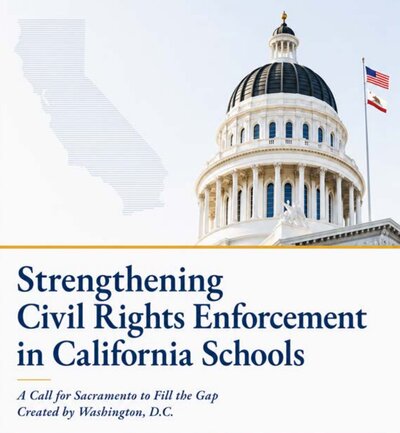
The 2026 report
Strengthening Civil Rights Enforcement in California Schools
A 2026 report from a coalition of civil rights organizations, Strengthening Civil Rights Enforcement in California Schools, argues that states have a duty to protect students’ civil rights and ensure equal access to an education. The report recommends four ways to strengthen civil rights enforcement in California schools.
1 Increase the capacity to enforce the Uniform Complaint Procedures (UCP)
| OCR | Office for Civil Rights (federal) |
| CDE | California Department of Education |
| LEA | Local educational agency (California), usually a school district |
| UCP | Uniform Complaint Procedures (California) |
| CCR | California Code of Regulations |
| CRD | Civil Rights Department (California) |
| Title IX | Sex discrimination law (federal) |
| Title VI | Civil Rights Act of 1964 (federal) |
| ADA | Americans with Disabilities Act (federal) |
California students can file discrimination or harassment complaints with their school district through the Uniform Complaint Procedures (UCP). These procedures are California’s standard process for filing complaints, including discrimination and harassment, against a school district or charter school.
If a student disagrees with a school district’s decision, they can appeal to the California Department of Education (CDE), but prepare to wait: limited resources constrain its ability to investigate cases in a timely manner.
The report suggests increasing the CDE’s ability to investigate more UCP appeals and expanding the authority of direct state intervention to provide more resources to students deprived of an equal education.
2 Empower students to file a complaint directly with the state
Right now, the California Code of Regulations permits direct CDE intervention in some cases without waiting for an investigation. If the procedures are revised to expand the scope of direct state intervention, California’s capacity to respond to discrimination would increase, but it would require additional funding.
3 Promote transparency
The report urges the CDE to publish data on a more regular basis.
4 Formalize interagency coordination
The state agency charged with enforcing California’s civil rights laws is the California Civil Rights Department (CRD). It has deep expertise in civil rights enforcement, but state law keeps it out of most complaints about educational equity, meaning discrimination claims under the Education Code. (The CRD can still act on some school cases, such as threats or violence under the Ralph Civil Rights Act, or complaints from school employees.) Otherwise, it can investigate only limited systemic complaints, through a process known as a Director’s Complaint.
The report suggests that California could remove this limitation and establish referral pathways that enable individual public school students to file complaints with the CRD. The aim would be to formalize interagency coordination. The CDE, the California Department of Justice’s Bureau of Children’s Justice, and the CRD would establish referral pathways so that complaints revealing systemic misconduct could trigger broader investigations and stronger enforcement actions.
What do you think?
Have you used the Uniform Complaint Procedures? What was your experience? Do the recommendations make sense to you? Leave a comment.
Tags on this post
All Tags
A-G requirements Absences Accountability Accreditation Achievement gap Administrators After school Algebra API Arts Assessment At-risk students Attendance Beacon links Bilingual education Bonds Brain Brown Act Budgets Bullying Burbank Business Career Carol Dweck Categorical funds Catholic schools Certification CHAMP Change Character Education Chart Charter schools Civics Class size CMOs Collective bargaining College Common core Community schools Contest Continuous Improvement Cost of education Counselors Creativity Crossword CSBA CTA Dashboard Data Dialogue District boundaries Districts Diversity Drawing DREAM Act Dyslexia EACH Early childhood Economic growth EdPrezi EdSource EdTech Education foundations Effort Election English learners Equity ESSA Ethnic studies Ethnic studies Evaluation rubric Expanded Learning Facilities Fake News Federal Federal policy Funding Gifted Grade inflation Graduation rates Grit Health Help Wanted History Home schools Homeless students Homework Hours of opportunity Humanities Independence Day Indignation Infrastructure Initiatives International Jargon Khan Academy Kindergarten LCAP LCFF Leaderboard Leadership Learning Litigation Lobbyists Local control Local funding Local governance Lottery Magnet schools Map Math Media Mental Health Mindfulness Mindset Motivation Myth Myths NAEP National comparisons NCLB Nutrition Pandemic Parcel taxes Parent Engagement Parent Leader Guide Parents peanut butter Pedagogy Pensions personalized Philanthropy PISA Planning Policy Politics population Poverty Preschool Prezi Private schools Prize Project-based learning Prop 13 Prop 98 Property taxes PTA Purpose of education puzzle Quality Race Rating Schools Reading Recruiting teachers Reform Religious education Religious schools Research Retaining teachers Rigor Rubrics School board School choice School Climate School Closures Science Serrano vs Priest Sex Ed Site Map Sleep Social-emotional learning Song Special ed Spending SPSA Standardized tests Standards Strike STRS Student motivation Student voice Success Suicide Summer Superintendent Suspensions Talent Taxes Teacher pay Teacher shortage Teachers Technology Technology in education Template Test scores Tests Time in school Time on task Trump Undocumented Unions Universal education Vaccination Values Vaping Video Volunteering Volunteers Vote Vouchers Winners Year in ReviewSharing is caring!
Password Reset
Search all lesson and blog content here.
Login with Email
We will send your Login Link to your email
address. Click on the link and you will be
logged into Ed100. No more passwords to
remember!









Questions & Comments
To comment or reply, please sign in .