



Education on the California ballot, 2026
Elections matter
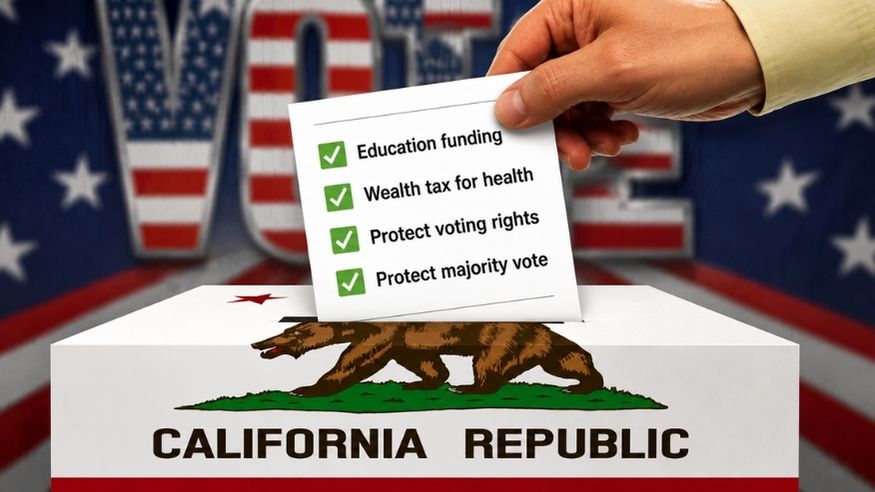
In California, ballot measures have had a huge impact on policies that affect children and the communities that support them. In November, voters will be called on again to make big decisions.
Editorial: Ed100 recommendations for selected measures on the 2026 state ballot
Ed100 Recommendations
(Click to jump to them)
Prop. 3: YES - Sustains funding for schools
Prop. 39: NO - Creates obstacles to voting
Prop. 40: YES - New funds for health care (billionaire’s tax)
Prop. 41: NO - Trojan horse for Prop. 40
Prop. 42: NO - Trojan horse for Prop. 40
Prop. 43: NO - Limits voters’ right to raise local revenues
What is a "Trojan horse" measure?
This post explains what’s at stake, along with the reasoning behind our recommendations as advocates for California’s children.
In November, you will decide three important issues:
- Will California sustain funding for public education? (Yes on Prop. 3.)
- Will California require its billionaires to support funding for the health of children and families? (Yes on Prop. 40. No on Trojan horse measures 41 and 42.)
- Will California protect voting rights and sustain communities’ local authority to tax themselves by majority vote? (No on Prop. 39 and No on Prop. 43)
3 Prop. 3 (2026): Sustain funding for schools
Initiative Constitutional Amendment
Provides Permanent Funding for Schools and Health Care by Extending Existing Tax on High Incomes.
Ed100 recommendation:
YES on Prop. 3 (2026)
For more than a decade, an existing tax on high-income earners has helped fund public education in California. Revenue from this source has helped pay for special education, community schools, before- and after-school programs, summer learning, teacher support, dual enrollment in college courses, bilingual education, and universal school meals.
California voters put this tax in place because without it school funding in the state was among the lowest in the nation. It has boosted California’s rank in education funding from near the bottom of the nation to the middle of the pack. (See chart below, from Ed100 Lesson 8.1.)
This investment has helped California schools sustain learning results, narrowing the achievement gap between California and other better-funded states.
Proposition 3 (2026), if passed, would make this funding source permanent. If it fails, the funding would end in 2031. If passed, it will continue to support both public TK-12 schools and public community colleges.
|
Tax Rates |
Tax rates apply to personal income over about $360,000 for single filers, $721,000 for joint filers, and $490,000 for heads of household (2024 levels; adjusted annually for inflation). |
|
How is education money divided? |
About 89% of Prop. 98 funds go to K-12 schools, 11% to community colleges. |
|
Who decides how money is spent? |
Local school boards decide how revenues are spent. |
|
What else gets funded? |
Increases General Fund revenues available for education, healthcare, budget reserves, and other programs. |
If voters reject Prop. 3, the impact on students and schools would be significant and harmful. We recommend YES on Prop. 3.
|
Points of View |
|
|
For |
Californians for Protecting Public Education, Health Care and Budget Stability |
|
Against |
|
40 Prop. 40 (2026): Billionaire tax for health care
Initiative Constitutional Amendment and Statute
Imposes One-Time Tax on Certain Taxpayers.
Read the proposition | Legislative analysis | Cal Budget Center
Ed100 recommendation:
YES on Prop. 40 (2026)
Commonly known as the “Billionaire tax,” this measure would impose a one-time tax of 5% on California taxpayers and trusts with assets valued over $1 billion. Business Insider estimates that there are a few hundred of them.
If passed, the Legislative Analyst estimates the state probably would collect tens of billions of dollars from the wealth tax in one-time funds, primarily for health care. The taxes could be paid over a period of years.
It is expected to be one of the most controversial and expensive ballot measures in recent memory.
Lost in the highly funded battle over this measure is the reason why it’s on the ballot. Passage of the federal One Big Beautiful Bill in 2025 lowered taxes for high earners, including billionaires. At the same time, it removed substantial federal funding for health care, with the costs passed to the states, including California. You can find here a list of significant health care cuts in the California 26-27 budget caused by the changed federal policy.
According to analysis by the California Department of Health Care Services,
“Up to 3.4 million Californians could lose their Medi-Cal coverage and the state could lose about $30 billion in federal funding every year due to H.R. 1, signed into law by President Trump in July 2025 — destabilizing the health care system and driving up health care costs for everyone.”
|
Prop. 40 |
|
|---|---|
|
Tax rate |
Imposes a one-time tax of up to 5% on taxpayers and trusts with covered assets valued over $1 billion. The tax would be due in 2027. |
|
Who is taxed? |
Billionaires who were residents of California on January 1, 2026. Many of them gained their wealth as executives or investors in California technology companies. These taxpayers would have the option to spread the payments over five years but would have to pay more to do so. |
|
What wealth is taxed? See note below about “Trojan Horse” provisions in Prop 41 and Prop 42. |
Covered assets include businesses, securities, art, collectibles, and intellectual property, but exclude real property and some pensions and retirement accounts. |
|
How are revenues spent? |
Allocates 90% of these tax revenues for health care services for the public. The rest would be spent on education, food assistance, and administration of the wealth tax. Prohibits using revenues to replace existing funding for these purposes. |
|
What are examples of how this will be used for health care? |
To restore or address any reductions in federal funding or state appropriations investments to protect or enhance Medi-Cal and other health coverage programs for low and moderate-income individuals; Support for safety net health care providers serving vulnerable populations; Prevent or mitigate facility closures or reductions in service levels; and other investments to support health care access, coverage, benefits, funding, services, and payments to providers. |
|
How is money spent for education? |
Education-related expenditures to restore or address any reductions in federal funding or state appropriations, or to make investments to protect or enhance the K-14 public education system. Food assistance expenditures to restore or address any reductions in federal funding or state appropriations, or further investments in programs such as CalFresh, CalFAP, CalFood or California's Universal Meals Program for school meals. |
|
Who decides how the money is spent? |
The Legislature has the authority to appropriate up to $22.5 billion each fiscal year from the Billionaire Tax Health Account and up to $2.5 billion each year from the Billionaire Tax Education and Food Assistance Account. |
|
What are the special tax exemptions? See note below about “Trojan Horse” provisions in Prop 41 and Prop 42. |
This money is not part of the general state budget. It is a special tax that can only be used for specific purposes. Tax revenues for education are in addition to constitutional requirements for school funding (Prop. 98). It is not subject to budget reserves or state spending limits. |
|
Summary of estimate of fiscal impact |
Temporary increase in state revenues from a new tax on the wealth of billionaires. These wealth tax revenues probably would add up to tens of billions of dollars spread over several years. Likely ongoing decrease in state income tax revenues of hundreds of millions of dollars or more per year. |
Prop. 40 is not an answer to ongoing wealth inequality. It is not an education reform bill. It is a one-time tax to pull California out of a sudden, acute healthcare crisis created by the federal government. It does not solve the state’s need for steady, ongoing revenue for health care — but it buys time to find solutions, hopefully including restored federal support.
When families lose access to health coverage, the repercussions for children can be severe. As we examine in Ed100 lesson 2.2, when families are insecure about basic needs like food, housing, and health, learning suffers.
|
Points of View |
|
|---|---|
|
For |
|
|
Against |
|
What are “Trojan Horse” provisions?

A Trojan Horse is a deceptive ploy that gains acceptance by hiding its real purpose. Opponents of Prop. 40 have introduced two initiatives, Prop. 41 and Prop. 42, that include sneaky fine print. Each is designed as a mechanism that might invalidate Prop. 40 even if a majority votes to approve it.
Sneaky fine print in Prop. 41 and Prop. 42
The state’s nonpartisan Legislative Analyst Office (LAO) blandly acknowledges these Trojan Horse provisions as “Potential Interactions With Other Propositions.” Here's what that means:
|
Trojan Horse provisions, explained |
|
|---|---|
|
Prop. 41 (see text) |
Prop. 42 (see text) |
|
“If Proposition 41 receives more "yes" votes than Proposition 40 on this same ballot, then Proposition 40 could be stopped from becoming law even if it gets yes votes from a majority of voters. This is because the courts could find that Proposition 41 conflicts with Proposition 40.” — LAO |
“If Proposition 42 receives more "yes" votes than Proposition 40 on this same ballot, then Proposition 40 could be stopped from becoming law even if it gets yes votes from a majority of voters. This is because the courts could find that Proposition 42 conflicts with Proposition 40.” — LAO |
|
The setup: Prop 40 revenue is excluded from the state spending limit. |
The setup: Prop 40 is a wealth tax on property of billionaires who were residents of California on January 1, 2026. This property includes things such as “businesses, securities, art, collectibles, and intellectual property, but excludes real property and some pensions and retirement accounts.” |
|
The sting: Prop 41. Trojan Horse provision: PROHIBITS NEW STATE TAXES THАТ EXСLUDE REVENUES FROM STATE SPENDING LIMIT. Source: California Secretary of State |
The sting: Prop 42 Trojan Horse Provision: PROHIBITS NEW STATE PERSONAL PROPERTY TAXES AND CERTAIN RETROACTIVE STATE TAXES. Prohibits any new state tax (1) imposed on the ownership of personal property (all things people own other than real estate), or (2) that applies retroactively based on the taxpayer's past activities. Nullifies taxes enacted after January 1, 2026 that conflict with this measure. Source: California Secretary of State |
41 Prop. 41 (2026): Tax audits… and Trojan Horse
Initiative Constitutional Amendment
Prohibits new state taxes that exclude revenues from state spending limit. Requires audits for new state special taxes.
Ed100 recommendation:
NO on Prop. 41 (2026)
Who could be against good auditing practices, right? Proponents of this measure say it would tighten accounting requirements to fight waste, fraud and abuse. This is nonsense.
Actually, the measure has two main aims: First and foremost, it’s a Trojan Horse to make the proposed billionaire’s tax go away. Prop. 40 dies if Prop. 41 or 42 passes with more votes. Why bother defeating a popular measure if you can just nullify it more cheaply with a Trojan horse?
According to Will McCarthy, writing for Politico, the funders of the campaigns to pass Prop. 41 and Prop. 42 are pouring money into this strategy. “The resources of all those [no on Prop. 40] committees combined pale in comparison to the war chest that has been amassed to pass Prop 41 and Prop 42, counter measures that would neuter a billionaire tax.”
The second, less hidden but complicated aim of Prop. 41 is to block all future special state taxes from being exempt from the State Appropriations Limit (also known as the Gann Limit), a set of rules that the voters of 1979 amended into the state constitution. The California Department of Education explains that the Gann Limit “was approved by voters with the goal of keeping state and local government spending, including school spending, capped at 1978–79 levels, adjusted for changes in population and inflation.”
|
Points of View |
|
|---|---|
|
For |
|
|
Against |
See Ballotpedia. |
42 Prop. 42 (2026): Ban new property taxes… and Trojan Horse
Initiative Constitutional Amendment
Prohibits new state personal property taxes and certain retroactive state taxes.
Ed100 recommendation:
NO on Prop. 42 (2026)
Like Prop. 41, this proposition is first and foremost a Trojan Horse: if passed with more votes than Prop. 40 gets, a court probably would prevent the Prop. 40 wealth tax on billionaires from taking effect.
Even more broadly, according to CalMatters, the measure would help generational wealth to escape being taxed at all. “Proposition 42 is meant to make it much harder to create a wealth tax in California by prohibiting new taxes on the mere ownership of assets such as investment accounts, business interests and personal property — assets that are typically only taxed when they are sold or generate income.”
As with federal taxes, California currently allows large unrealized gains to escape capital-gains taxation through inheritance at death using stepped-up basis. Proposition 42 would not change that rule, and it would constitutionally restrict California from addressing accumulated wealth through a new tax on ownership of stocks, business interests and other personal assets.
|
Points of View |
|
|---|---|
|
For |
|
|
Against |
See Ballotpedia. |
39 Prop. 39 (2026): Voter identification
Initiative Constitutional Amendment
Prohibits citizens from voting unless they present government-issued identification.
Ed100 recommendation:
NO on Prop. 39 (2026)
Mistrust of the electoral process has become a recurring theme of political communication in America. Voter fraud is so rare that the Brennan Center for Justice characterizes it as a myth. The California Secretary of State provides a website that is designed to provide clear and accurate information in response to some of the most widespread misconceptions about elections.
Still, the myth of voter fraud is sufficiently powerful that it has political value. In 2026, political donors, mostly right-leaning, have contributed big money to cover the cost of a ballot measure that would make voting a bit harder. California voters will be asked to weigh in.
California already validates the identification of voters when they register to vote. Proposition 39, if passed, would require the process each time they vote. It would add new costs and logistical obstacles to the process and prevent or discourage some from casting their ballot.
|
Major Provisions of Prop. 39 (2026) |
|
|---|---|
|
What additional identifying information is required to vote? |
In-person voting: When voting in person, Proposition 39 requires voters to present government-issued identification for identity verification. The measure provides for workarounds, but without complete detail. Workarounds will inevitably require extra time and processing, which will make them an obstacle to voting. Voting by Mail: When voting by mail, Proposition 39 requires voters to provide the last four digits of their selected government-issued identification number on the ballot envelope. Elections officials would verify that the identification numbers provided on the ballot envelope match the voter’s registration information. |
|
What do you need for identification? |
New and existing voters select a government-issued identification in their voter registration to vote by mail. |
|
Are there audit requirements? |
In every odd-numbered year, Proposition 39 requires the State Auditor to report how well the state and each county comply with the measure and make recommendations for improvement. |
|
What is the fiscal impact? |
According to the California Legislative Analyst Office (LAO), Proposition 39 would increase state and local government costs each year by tens of millions of dollars to low hundreds of millions of dollars. |
Many people do not routinely carry government identification documents around with them, especially if they don’t drive. They would have to make a special point of finding and bringing documents along with them to vote. The measure would particularly affect voters who change their name, for example when marrying.
Transitioning to new more stringent requirements for identification at the voting booth would make it more burdensome for voters.
|
Points of View |
|
|---|---|
|
For |
|
|
Against |
|
43 Prop. 43 (2026): Voter rights - tax threshold
Legislative Constitutional Amendment:
Limits Voters’ Ability to Raise Revenues for Local Government Services.
Ed100 recommendation:
NO on Prop. 43 (2026)
California, famously, empowers voters to directly pass laws and even amend the state constitution through direct democracy both at the state level and at the local level.
The California Legislative Analyst Office (LAO) explains:

In the Ed100 blog
Wish granted: Majority voting rights
“The State Constitution allows local governments to increase taxes with local voter approval. Tax increases can be put on a ballot by voters or by a local governing board (such as a city council or board of supervisors).”
Local taxes that are put on the ballot by a governing board for a specific purpose require a two-thirds vote to be approved.
However, the two-thirds vote requirement does not apply to citizen initiatives. That is, when local voters place a local tax on their local ballot for a special purpose, it may be approved by a majority vote of those local voters. This principle was established by the state Supreme Court in 2017.
Proposition 43, if passed by a mere majority vote, would — ironically — remove the right for local citizens to pass local initiatives by a majority vote. Beginning on January 1, 2027, any new, increased, or extended local special taxes proposed by local voters would require a two-thirds vote.
Should a majority vote have the power to invalidate future majority votes?
This initiative is an offense to California’s democratic heritage and the principle of local control. It would also undermine local communities' right to act on local needs, including support for their libraries, sports and recreation, child care, and schools.
|
Points of View |
|
|---|---|
|
For |
|
|
Against |
|
Tags on this post
All Tags
A-G requirements Absences Accountability Accreditation Achievement gap Administrators After school Algebra API Arts Assessment At-risk students Attendance Beacon links Bilingual education Bonds Brain Brown Act Budgets Bullying Burbank Business Career Carol Dweck Categorical funds Catholic schools Certification CHAMP Change Character Education Chart Charter schools Civics Class size CMOs Collective bargaining College Common core Community schools Contest Continuous Improvement Cost of education Counselors Creativity Crossword CSBA CTA Dashboard Data Dialogue District boundaries Districts Diversity Drawing DREAM Act Dyslexia EACH Early childhood Economic growth EdPrezi EdSource EdTech Education foundations Effort Election English learners Equity ESSA Ethnic studies Ethnic studies Evaluation rubric Expanded Learning Facilities Fake News Federal Federal policy Funding Gifted Grade inflation Graduation rates Grit Health Help Wanted History Home schools Homeless students Homework Hours of opportunity Humanities Independence Day Indignation Infrastructure Initiatives International Jargon Khan Academy Kindergarten LCAP LCFF Leaderboard Leadership Learning Litigation Lobbyists Local control Local funding Local governance Lottery Magnet schools Map Math Media Mental Health Mindfulness Mindset Motivation Myth Myths NAEP National comparisons NCLB Nutrition Pandemic Parcel taxes Parent Engagement Parent Leader Guide Parents peanut butter Pedagogy Pensions personalized Philanthropy PISA Planning Policy Politics population Poverty Preschool Prezi Private schools Prize Project-based learning Prop 13 Prop 98 Property taxes PTA Purpose of education puzzle Quality Race Rating Schools Reading Recruiting teachers Reform Religious education Religious schools Research Retaining teachers Rigor Rubrics School board School choice School Climate School Closures Science Serrano vs Priest Sex Ed Site Map Sleep Social-emotional learning Song Special ed Spending SPSA Standardized tests Standards Strike STRS Student motivation Student voice Success Suicide Summer Superintendent Suspensions Talent Taxes Teacher pay Teacher shortage Teachers Technology Technology in education Template Test scores Tests Time in school Time on task Trump Undocumented Unions Universal education Vaccination Values Vaping Video Volunteering Volunteers Vote Vouchers Winners Year in ReviewSharing is caring!
Password Reset
Search all lesson and blog content here.
Login with Email
We will send your Login Link to your email
address. Click on the link and you will be
logged into Ed100. No more passwords to
remember!









Questions & Comments
To comment or reply, please sign in .